
How Landscaping Businesses Are Getting Found Online: The Case for Hiring an SEO Company
Last month a landscaping owner from Charlotte sent me six months of “SEO reports” from his previous agency. Beautiful PDFs. Branded dashboards. Graphs showing 847 “keyword impressions” and a 23% increase in “organic visibility.”
His question: “Why didn’t my phone ring more?”
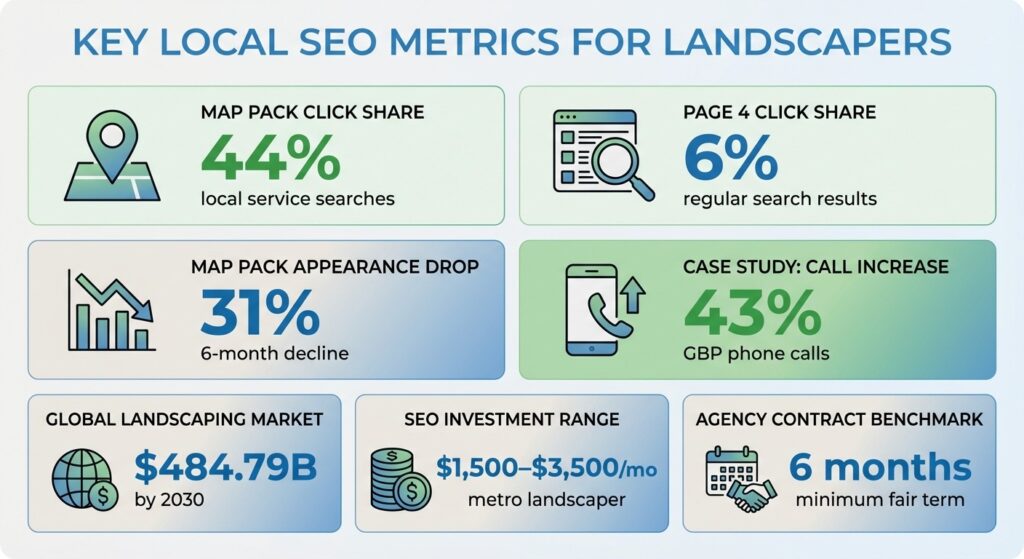
I pulled his Google Business Profile. In those same six months, his map pack appearances had dropped 31%. His competitors were showing up for “landscaping near me” and “lawn maintenance Charlotte” while his company sat on page two. The agency had optimized his site for keywords like “xeriscaping design philosophy” and “sustainable landscape architecture”—terms his actual customers never searched.
The Local SEO Reality Most Agencies Ignore
Your customers search differently than someone hiring a SaaS consultant or buying running shoes online. They type “landscape company near me” or “spring cleanup service” plus their zip code. They click the map pack, read reviews, and call the top three listings.
When I audit SEO contracts for landscaping companies, the biggest gap isn’t technical—it’s geographic. If your SEO company isn’t treating Google Maps visibility as the primary battleground, they’re optimizing for the wrong game.
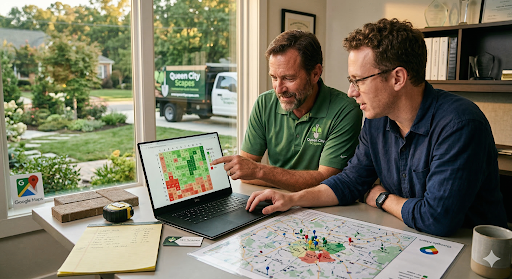
A legitimate landscaping seo company should show you exactly where you appear in the map pack for your core service areas before discussing anything else. Not “rankings” on page one of regular search results—actual map positions for terms like “lawn care [your city]” and “landscape maintenance [your zip code].”
The map pack generates 44% of clicks for local service searches, while position four on the regular results page gets maybe 6%.
The industry is growing—market projections show the global landscaping services sector reaching $484.79 billion by 2030—which means more competition for those map pack spots. Your SEO company needs to prove they can defend and improve your Google Maps placement.
Ask them to screen-share their Google Maps audit process during the sales call. If they deflect to “we’ll send a report later,” they don’t prioritize local.
What a Real Map Pack Audit Includes
| Audit Component | What They Should Show You | Why It Matters |
|---|---|---|
| Current Rankings | Map pack positions for 10-15 core service + location combinations | Shows actual visibility where customers search |
| Competitive Comparison | Your GBP optimization score vs. top 3 competitors | Reveals specific gaps to address |
| Review Metrics | Review velocity, rating trends, response rates | Directly impacts map pack placement |
| Engagement Data | GBP post frequency and interaction rates | Signals active, relevant business to Google |
If they can’t produce this in real time, they’re either unprepared or they don’t track the metrics that drive estimate requests.
The second layer is on-page local signals. Your service pages should target specific cities or neighborhoods you serve, not generic “landscaping services” content. Each major service needs its own page, with location-specific content, schema markup declaring your service area, and internal links connecting related services. An agency that understands landscaping business models will ask about your route density and service radius before building site architecture.
What Deliverables Actually Prove They’re Working
The “rank report” problem is real. I’ve reviewed contracts where the agency sends a monthly PDF showing 50 keywords and their positions, with zero context about whether those keywords matter.
Demand these specific artifacts before signing anything:
Call Tracking Numbers (Day One, Not “Eventually”)
Active call tracking from day one, with recordings you can access. You need to hear which keywords and landing pages are generating actual estimate requests versus tire-kickers. The agency should provide a monthly breakdown: X calls from organic search, Y from map pack, Z from service pages, with call duration and outcome notes.
If they resist call tracking because “it’s expensive” or “not necessary,” they don’t want you measuring their actual impact.
Google Business Profile Insights Exports
Your GBP dashboard shows how many people found your profile through search versus maps, which search queries triggered your listing, how many clicked for directions or visited your website, and how many called directly. A competent agency pulls this data monthly and compares it to the previous period and the same month last year to account for seasonality.
They should explain why “lawn aeration” queries spiked in September or why direction requests dropped in January—and what they’re doing about it.
Keyword Research That Reflects Real Customer Behavior
Not a 500-row spreadsheet of every possible keyword—it’s a focused list of 30-50 terms organized by service type and location, with search volume, current ranking, and competitive difficulty. More importantly, it should show their prioritization logic.
Why are they targeting “spring cleanup [city]” before “landscape design [city]”?
The answer should reference your business model: spring cleanup is high-volume, quick-turn work that fills the schedule, while design projects take longer to close but have higher margins.
Content Calendar Tied to Your Seasonal Business Cycle
Landscaping isn’t steady year-round. You need content about spring cleanup in February and March, irrigation startup in April, mosquito control in May, lawn renovation in September, leaf removal in October, and winter services in November.
The agency should map content topics to your actual service calendar and local search trends.
The Case Study Test: Separating Real Results from Marketing Theater
Every agency has case studies. Most are useless.
I recently walked through a case study with an owner considering two agencies. Agency A showed a “home services company” with a 127% increase in organic traffic. No industry specified, no location, no mention of leads or revenue.
Agency B showed a landscaping company in a similar-sized market, with before/after map pack rankings for 12 service + location combinations, a 43% increase in GBP phone calls, and a breakdown of which service pages drove the most estimate requests. Agency B also included screenshots of the client’s call tracking dashboard and a testimonial video where the owner specifically mentioned signing 18 new maintenance contracts attributed to organic search.
Questions to Ask About Any Case Study
- If they show traffic increases: Ask for corresponding lead volume
- If they show ranking improvements: Ask for map pack positions specifically
- If they show “ROI”: Ask how they calculated it—did they track closed jobs back to organic search?
The best case studies include a methodology section explaining what they actually did. For a landscaping client, that might look like: “Month 1-2: Optimized GBP with service-specific posts, added 200+ geo-tagged photos, implemented review request system. Month 3-4: Built 12 location-specific service pages, added schema markup, created seasonal content calendar. Month 5-6: Earned citations from local business directories, partnered with complementary trades for backlinks.”
This level of detail tells you they have a repeatable process.
Ask if you can speak to the client featured in the case study. Legitimate agencies will facilitate this. If they refuse or make excuses, the case study might be exaggerated or the client relationship might have ended poorly.
Red Flags That Should End the Conversation
Some warning signs are immediate disqualifiers.
They Want to “Own” Your Google Business Profile
If an agency says they need to “own” your Google Business Profile to optimize it, walk away. Your GBP is tied to your business identity—you should always maintain owner access, and the agency should work as a manager. I’ve seen too many situations where the owner tries to leave and discovers the agency registered the profile under their email, holding it hostage.
They Promise “First Page Rankings in 30 Days”
They’re either lying or planning to use tactics that will get you penalized. Local SEO for competitive landscaping markets takes 3-6 months to show meaningful movement. Similarly, if they guarantee “X number of leads per month,” ask how they’ll refund you when they miss.
They Won’t Show You Their Actual Work
If they won’t show you the content they’re publishing, the backlinks they’re building, the technical changes they’re making—that’s a transparency problem. You’re paying for a service; you deserve to see the work product.
Contract Terms That Trap You
Watch for contract terms that lock you in for 12+ months with no performance clauses. A confident agency will offer 6-month agreements with clear benchmarks: if we don’t achieve X map pack improvements and Y% increase in organic calls by month six, you can exit without penalty.
The Questions That Reveal Whether They Understand Your Business
I tell owners to ask these questions during the sales call and judge the agency by how they respond.
“How do you handle seasonality in landscaping SEO?”
The right answer acknowledges that search volume for “spring cleanup” peaks in March-April, “mosquito control” peaks in May-June, and “leaf removal” peaks in October-November, and they adjust content and ad spend accordingly.
“What happens to my rankings if I pause service?”
This tests whether they’re building sustainable organic authority or just propping you up with tactics that collapse when you stop paying. A good agency will explain that your map pack position and domain authority persist, though you’ll lose momentum on new content and ongoing optimization.
“How do you differentiate our company from the 15 other landscapers in our market?”
This forces them to discuss positioning and messaging, not just technical SEO. They should ask about your specialties—do you focus on high-end residential, commercial properties, or maintenance contracts? Your SEO strategy should emphasize what makes you different.
“Can you show me an example of content you’d create for our blog?”
If they describe generic articles like “5 landscaping trends for 2026,” they’re not thinking strategically. Better content ties to your service calendar and local search intent: “When to schedule spring lawn aeration in [your region]” or “Comparing irrigation systems for [local climate] summers.”
What Fair Pricing Actually Looks Like
For a landscaping business serving a metro area with 200,000-500,000 population, expect to invest $1,500-$3,500 monthly for comprehensive local SEO. That should include GBP optimization, on-page SEO for 10-15 service pages, content creation (2-4 articles monthly), citation building, review management, technical maintenance, and monthly reporting with call tracking.
Lower than $1,500 usually means you’re getting a cookie-cutter package with minimal customization. Higher than $3,500 should come with expanded scope: maybe you serve multiple cities and need separate location pages, or you’re in a highly competitive market.
The U.S. market growth projections show steady demand, which means your investment in visibility compounds over time. A maintenance contract you sign in year one from organic search continues generating revenue in years two and three, while your SEO costs stay relatively flat.
Pricing Structure Options
- Flat Monthly Retainers: Predictable costs, clear deliverables each month
- Tiered Packages: Choose your service level based on competition and goals
- Performance-Based Pricing: Rare in SEO (too many variables outside agency control)
I prefer flat retainers with clear deliverables because it aligns incentives—they’re motivated to show results so you keep paying, but they’re not penalized for factors like your sales team’s close rate.
The Vetting Playbook: Your First 30 Days
Here’s how I recommend owners structure the evaluation process.
Week One: Initial Consultations
Schedule calls with 3-5 agencies and ask the questions I outlined above. Take notes on how they respond, whether they ask about your business model, and whether they show you real examples of their work.
Week Two: Verify Case Studies
Request case studies and verify them. Call the references, ask specific questions about communication, results, and whether they’d hire the agency again.
Week Three: Request Preliminary Audits
Ask your top two finalists to conduct a preliminary audit of your current online presence. They should identify your biggest gaps—maybe your GBP isn’t fully optimized, or your service pages lack location-specific content, or you have zero reviews from the past six months.
Week Four: Compare Proposals Side-by-Side
Review proposals not just for pricing, but deliverables, contract terms, reporting frequency, and communication structure. Will you have a dedicated account manager? How quickly do they respond to questions?
Before you sign, ask for a sample monthly report from another client (with sensitive data redacted). This shows you exactly what you’ll receive and whether it focuses on the metrics that matter—map pack positions, organic calls, estimate requests—or vanity metrics.
Making the Decision With Confidence
I started doing these audits because I watched too many good landscaping companies waste $20,000-$40,000 on SEO agencies that delivered nothing but reports.
You don’t have to be an SEO expert to choose the right partner. You need to be a skeptical operator who demands proof, asks for specifics, and walks away from vague promises. The right agency will welcome your questions because they know their results speak for themselves.
Your goal isn’t to find the cheapest option or the one with the slickest sales pitch.
It’s to find the agency that understands how landscaping businesses actually make money—through route density, seasonal service mix, and converting estimate requests into signed contracts—and can prove they’ve delivered those outcomes for similar companies in competitive markets.
Start with the Google Maps audit. If they can’t show you where you currently rank in the map pack for your core services and locations, or if they dismiss it as “just one factor,” keep looking.
Everything else in SEO supports that foundation. Get the local visibility right, and the estimate requests follow.