

What to Look for in a Remodeling Marketing Agency: A Practical Guide for Contractors
I spent Tuesday morning on a call with a kitchen-and-bath contractor who’d just fired his third agency in eighteen months. Same story I’ve heard a dozen times: $3,200/month retainer, a dashboard full of “impressions” and “engagement,” zero qualified leads.
When I asked what the agency actually did in month one, he couldn’t tell me.
That’s the problem—most remodeling business owners sign contracts before they understand what they’re buying, how it’ll be measured, or whether the agency has ever worked a sales cycle longer than forty-eight hours.
What You’re Actually Buying (And What Gets Sold Instead)
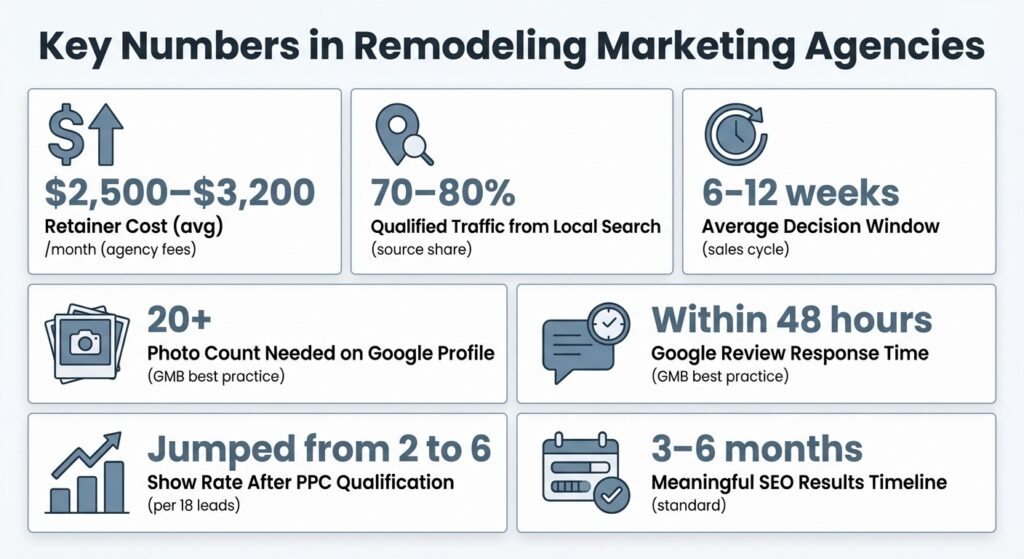
When an agency pitches “digital marketing for home services,” they’re usually selling a template: generic local SEO, a Google Ads campaign cloned from HVAC or plumbing, maybe some Facebook posts about “spring renovations.” None of that accounts for what makes remodeling different—the six-to-twelve-week decision window, the showroom or in-home consult that happens before commitment, the fact that a $40,000 bathroom remodel isn’t an impulse buy.
Starting With Your Sales Process, Not Their Template
The right scope starts with your actual sales process. If you run a showroom, the agency should optimize for “near me” searches that drive foot traffic and track which online touchpoints preceded the visit. If you rely on in-home consultations, lead generation has to include qualification—budget range, project timeline, decision-maker involvement—so your estimators aren’t wasting Saturday mornings on tire-kickers.
A competent agency will define a qualified lead upfront—for most remodelers, that means local, budget-appropriate, project-ready within six months—and build campaigns that filter for those criteria before the phone rings.
Attribution That Fits Remodeling’s Reality
Remodeling isn’t ecommerce. You can’t measure “cost per conversion” if the conversion happens three months after the first click and involves two showroom visits, an estimate appointment, and a follow-up call. The agency needs to connect online behavior to offline outcomes using call tracking, CRM integration, or at minimum a disciplined lead-source field in your project management system.
If they can’t explain how they’ll tie a Google Ads spend to closed revenue, you’re buying hope, not a growth system.
Generic “Home Services” vs. Remodeling-Specific Strategy
Here’s what separates remodeling from other trades:
| Emergency Services (Plumbing, HVAC) | Remodeling & Renovation |
|---|---|
| Urgency-driven decisions | Aspiration and planning |
| Same-day booking | 6-12 week consideration |
| “Call now” messaging works | Educational content required |
| Price-focused shoppers | Value and confidence seekers |
| Short sales cycle | Multiple touchpoints needed |
A plumber’s marketing works on urgency: broken pipe, same-day service, book now. Remodeling is aspiration and planning. The homeowner has been saving, researching finishes, arguing about whether to go full gut or keep the original layout. Your marketing has to meet them in that longer consideration phase—educational content about design trends, financing options, permitting realities, portfolio work that shows craftsmanship.
I’ve seen agencies run PPC campaigns for remodelers using the same ad copy and landing pages they use for emergency services. High click-through rates, terrible conversion rates, because the messaging is mismatched.
The best remodeling marketing agency partners treat content as a qualification tool. They’ll build service pages that explain what a “design-build remodel” actually involves, blog posts that walk through permitting timelines, case studies with before-and-after photos and budget breakdowns. That content ranks for long-tail search terms and pre-educates prospects so the ones who reach out are already halfway sold.
Local SEO and Google My Business: The Foundation Most Agencies Ignore
If an agency pitches you on SEO without spending the first ten minutes talking about your Google Business Profile, walk away.
For remodeling companies, local search intent drives 70–80% of qualified traffic. Someone typing “kitchen remodeler near me” or “bathroom renovation [neighborhood]” is ready to talk. If your GMB profile isn’t optimized—detailed description, 20+ high-quality project photos, consistent NAP (name, address, phone) across directories, active review collection—you’re invisible in the map pack, which is where most clicks happen.
The GMB Audit That Reveals Everything
I audited a profile last month for a basement-finishing contractor who’d been paying an agency $2,500/month for “local SEO.” The GMB description was two sentences, the photo gallery had six stock images, and the last review response was from eleven months ago. Meanwhile, his competitors were ranking in the three-pack because they’d actually filled out their profiles.
Google rewards recency and completeness.
An agency that understands remodeling will add project-specific photos, update posts about seasonal promotions or recent projects, and respond to every review within forty-eight hours.
What proper GMB optimization includes:
- Complete business description with all services and service areas
- 20+ high-resolution project photos (not stock images)
- Weekly posts about recent projects or seasonal offers
- Review responses within 48 hours (every single one)
- Accurate categories and attributes
- Q&A section populated with common questions
- Service area boundaries properly defined
The other local SEO lever is citation consistency and local backlinks. Your business name, address, and phone number should match exactly across Yelp, Houzz, Angi, the Better Business Bureau, local chamber of commerce directories. Inconsistent NAP data confuses Google and dilutes your local authority.
Reading the GMB Insights That Matter
If your agency isn’t showing you monthly data on how people found your profile (direct search vs. discovery search vs. maps), what actions they took (website clicks, direction requests, phone calls), and how your visibility compares to competitors, they’re flying blind.
PPC and Lead Generation: Quality Over Volume, Always
Google Ads for remodeling is where most agencies burn client money fastest. They’ll set up a campaign targeting broad keywords like “kitchen remodel” or “bathroom renovation,” drive clicks at $8–$15 each, and deliver unqualified inquiries—people outside your service area, DIYers looking for advice, homeowners with $5,000 budgets for $30,000 projects.
Building Qualification Into Every Click
The fix is ruthless qualification before the click:
- Negative keywords to exclude DIY and budget terms (“cheap,” “DIY,” “cost,” “how to”)
- Geographic targeting locked to your actual service radius
- Ad copy that sets expectations: “Custom kitchen remodels starting at $40K”
- Landing pages with qualification questions: project type, budget range, desired start date
Every friction point you add will reduce form submissions, but the ones that come through will be worth your estimator’s time.
I worked with a deck-and-patio builder who was getting 40 leads a month from Google Ads and closing two. We tightened the targeting, rewrote the ads to emphasize “custom outdoor living,” and added a budget qualifier to the landing page. Lead volume dropped to 18 per month. Close rate jumped to six. Cost per qualified lead went down, cost per closed job dropped by half.
ROI Tracking That Actually Connects to Revenue
Here’s the conversation I have with every remodeling client: “What does a closed project look like in your CRM, and how do we tie it back to the marketing source?”
If the agency can’t answer that question in the first meeting, they’re not serious about ROI.
You need call tracking numbers on ads and landing pages. You need form submissions tagged with UTM parameters. And you need a process to update lead status in a shared system so the agency can see which leads turned into estimates, which estimates turned into signed contracts, and what the revenue was.
The Metrics That Actually Matter
Most agencies will show you “cost per lead” and call it a day. That’s a vanity metric.
What matters:
- Cost per qualified lead
- Conversion rate from lead to consultation
- Conversion rate from consultation to signed contract
- Average project value by lead source
- Total revenue attributed to marketing spend
If you’re spending $3,000/month on ads and closing two $50,000 remodels that you can trace back to those ads, your ROI is crystal clear. If you’re spending $3,000/month and closing two $8,000 bathroom refreshes, the math doesn’t work.
The best agencies build a monthly reporting rhythm that includes lead source breakdown, qualification rate, consultation show rate, and closed revenue by source. They’ll sit with you quarterly and ask, “Which lead sources are producing the highest-value projects?” and shift budget accordingly.
Running the Agency Interview: Questions That Reveal Competence (or Lack of It)
When you’re vetting agencies, treat it like a hiring process. You wouldn’t hire a project manager without checking references. Same here.
Question 1: Show Me Your Remodeling Experience
“Walk me through a remodeling client you’ve worked with—what was the scope, what did you do in the first 90 days, and what were the results?”
If they can’t name a specific client or they pivot to generic “home services” examples, that’s a red flag.
Question 2: Explain Your GMB Strategy
“What’s your process for auditing and improving a GMB profile, and how do you measure the impact?”
A competent answer includes photo strategy, review generation, post cadence, and GMB insights tracking.
Question 3: How Do You Qualify PPC Leads?
“How do you qualify leads before they hit my phone, and what’s a realistic cost-per-qualified-lead for a remodeling business in my market?”
They should talk about negative keywords, geographic targeting, budget qualifiers, and give you a ballpark based on your service area and average project value.
Question 4: Show Me Your Content Work
“Show me an example of a blog post or service page you’ve written for a remodeling client, and explain how it supports both search rankings and lead qualification.”
You want to see depth—posts that answer real homeowner questions, showcase expertise, and guide the reader toward a consultation.
Question 5: What Does Reporting Look Like?
“What does your reporting look like, and how often will we review it together?”
Monthly reporting should include traffic and ranking data, lead volume and quality metrics, and closed revenue by source. Quarterly business reviews should include strategic recommendations based on what’s working.
Red Flags That Should End the Conversation Immediately
Some warning signs are obvious, but contractors miss them because they’re eager to solve the marketing problem.
Walk away if:
If an agency guarantees “first-page rankings in 30 days” or “10x ROI in six months,” they’re either incompetent or dishonest. SEO takes time—three to six months to see meaningful movement, longer in competitive markets.
If they won’t share client references or case studies, or the references are all from other industries, that’s a problem. Remodeling marketing has specific challenges—long sales cycles, high-ticket purchases, local competition—and you want an agency that’s navigated those before.
If the contract locks you in for twelve months with no performance benchmarks or exit clauses, walk away. A confident agency will offer a 90-day trial or quarterly opt-out terms.
And if they can’t explain their pricing—what you’re paying for, how many hours or deliverables are included, what’s extra—you’re going to get nickel-and-dimed.
Your First 90 Days: What Good Agencies Actually Deliver
Once you’ve signed, the first three months should follow a clear roadmap.
Month One: Discovery and Foundation
The agency audits your current digital presence (website, GMB, citations, existing ad accounts), interviews you about sales process and ideal customer profile, sets up tracking and reporting infrastructure, and delivers a strategy document with priorities and timelines.
Month Two: Execution
GMB optimization goes live, citation cleanup is underway, PPC campaigns launch (if in scope), and content production starts. You should see weekly or biweekly updates with specific deliverables completed and early performance data.
Month Three: Optimization and Review
The agency analyzes what’s working, adjusts targeting and messaging based on lead quality feedback, and presents a 90-day report with clear metrics—traffic growth, ranking improvements, lead volume and quality, cost per lead, and early revenue attribution.
If an agency goes dark for weeks at a time, delivers vague updates, or can’t show tangible progress by month three, you’ve hired the wrong partner.
The Evaluation Checklist You Should Use
Before you sign anything, run through this:
- Have they worked with at least three remodeling or custom home-building clients, and can they share results?
- Do they understand your sales process and can they explain how their strategy maps to it?
- Will they optimize your Google Business Profile as a priority?
- Can they define what a “qualified lead” means for your business and show how they’ll filter for it?
- Do they have a clear plan for tracking ROI that connects online activity to closed revenue?
- Will they provide monthly reporting with lead quality metrics and quarterly strategy reviews?
- Are references available, and do those references describe a collaborative, responsive partnership?
- Is the contract fair—reasonable term length, clear deliverables, transparent pricing?
If you can check every box, you’ve found a partner worth testing. If you’re missing more than two, keep looking.
The right agency won’t just execute tactics—they’ll become an extension of your sales and growth team, someone who understands that every lead represents a homeowner’s biggest investment and your reputation on the line.