
What Makes a Landscaping Marketing Agency Worth Hiring and How to Spot the Ones That Aren’t
I spent five years running operations for a landscaping company with four crews, and now I audit marketing programs for owners who’ve been burned. The calls picked up after spring bidding season this year, and the pattern is consistent: someone spent $2,500 to $5,000 a month for six or nine months, got monthly reports full of charts, and can’t point to a single commercial contract or residential maintenance account that came from the spend.
When they ask the agency what happened, they hear “it’s the season” or “Google changed the algorithm” or “your close rate is the problem.”
The Real Cost of Hiring on Promises Alone
Most landscaping companies hire an agency based on the pitch, the price, and whether the salesperson seems to understand the business. That works fine when you’re buying mulch or renting equipment, because you can see the pile delivered or the machine running.
Marketing doesn’t show up in your driveway.
You get a dashboard, a call log, maybe some ranking reports. If those numbers don’t connect to actual bidding opportunities or signed contracts, you’re flying blind until the budget runs out. The mistake isn’t hiring help—it’s skipping the due diligence that would expose whether the agency has ever generated real ROI for a landscaping company.
I’ve reviewed programs where the agency ranked the client for “landscaping services near me” but never optimized for the commercial snow removal work that pays the bills in winter. I’ve seen Google Ads campaigns burning $150 a day on broad-match keywords that pulled in homeowner tire-kickers when the company only bids projects over $25,000. The agency hit its targets, sent the reports, collected the fee. The owner had nothing but frustration and a thinner cash cushion.
What ROI Actually Looks Like and How to Track It Before You Sign
Before you evaluate any agency’s pitch, define what return on investment means for your company.
If you spend $3,000 a month on marketing, you need to know how many leads you expect, what percentage should close, and what the average contract value is for the work you want.
A Realistic ROI Calculation
| Component | Value |
|---|---|
| Monthly marketing spend | $3,000 |
| Qualified leads delivered | 10 |
| Close rate on qualified leads | 20% |
| New contracts per month | 2 |
| Average contract value | $18,000 |
| Monthly revenue from new contracts | $36,000 |
| Net gain (first month) | $33,000 |
That’s ROI. If the agency can’t walk you through a similar calculation using their past client data, or if they deflect with vague language about “brand awareness” and “long-term growth,” you’re looking at a red flag.
Ask any agency you’re considering to show you their tracking setup before you sign. Real tracking means call recording and lead attribution through CallRail or CallTrackingMetrics, form submissions tagged by source in your CRM, and a shared dashboard where you can see cost per lead by channel.
If they say “we’ll set that up after onboarding,” push back.
Tracking should be in place from day one. I worked with one owner who’d been told his SEO campaign was “performing well” because organic traffic increased 40%. When we dug into the analytics, the traffic came from blog posts about DIY lawn care—homeowners looking for free advice, not commercial property managers looking for bids.
The agency hit a metric that sounded good in a report but delivered zero business value. That’s why you need to agree on lead quality definitions upfront: what counts as a qualified lead for your company, and what’s just noise.
Industry Experience, Case Studies, and the Proof You Should Demand
The best predictor of whether an agency will deliver for a landscaping company is whether they’ve already done it for someone similar.
Not “we’ve worked with home services companies” or “we know local SEO.”
Specifically: have they generated measurable leads and ROI for a landscaping business with a comparable service mix, market, and revenue model?
Three Elements Every Case Study Must Include
Client profile match. If you’re a commercial-focused operation doing $2 million a year, a case study about a residential lawn care startup isn’t relevant.
Hard numbers. Leads per month, cost per lead, close rate if they tracked it, and revenue attributed to the campaign.
Tactical details. Which keywords they targeted, how they structured the Google Ads account, what on-page SEO changes they made, how they handled reviews and local citations.
If the case study is just a testimonial quote and a graph showing “50% more traffic,” it’s marketing fluff, not proof.
I’ve seen agencies show up with polished presentations and zero landscaping clients in their portfolio. When pressed, they’ll say “we apply the same strategies across industries.” That’s not confidence—it’s risk transfer. They’re asking you to fund their learning curve while they figure out whether “hardscaping contractor” and “landscape design” are the same search intent (they’re not).
An agency with real industry experience already knows that spring and fall are bidding seasons, that snow removal keywords spike in November, and that a lead for a $50,000 installation project requires different nurturing than a call about weekly mowing.
Ask to speak with a current or past client in the landscaping space. A legitimate agency will facilitate that reference call. If the agency says “our clients are confidential” or offers only a written testimonial, that’s another red flag.
Reviews matter, too, but you need to read past the star rating. Look for reviews that mention specific outcomes—”we saw a 30% increase in qualified leads within three months” or “they helped us rank for commercial landscape maintenance in our city.” Generic praise like “great communication” doesn’t tell you whether they can execute.
SEO, Website Design, and Local Visibility: What to Verify Before You Pay
Search engine optimization is where a lot of landscaping companies get sold a bill of goods.
An agency will promise “page one rankings” without specifying for which keywords, or they’ll optimize your site for high-volume terms that don’t convert. SEO for a landscaping company should focus on local intent and service-specific keywords that match your revenue model.
If you do commercial work, your site needs dedicated service pages for commercial landscape maintenance, irrigation management, hardscaping, and whatever else you bid. Each page should target the keyword phrase a property manager or facilities director would actually search—”commercial landscaping services [city]” or “HOA landscape maintenance near me”—and include project examples, service details, and a clear call to action.
What a Proper SEO Audit Should Reveal
An agency should audit your existing site before proposing SEO work, and that audit should identify:
- Technical issues: Slow load times, mobile usability problems, broken links
- On-page gaps: Missing title tags, thin content, no local schema markup
- Off-page weaknesses: Few or low-quality backlinks, inconsistent NAP citations across directories
Ask to see the audit in writing. If they say “we’ll handle all that” without showing you what’s broken, you have no baseline to measure improvement.
Local SEO is non-negotiable for landscaping companies. Your Google Business Profile should be fully optimized: accurate hours, service areas defined, categories selected correctly, and photos that show your actual crews and completed projects.
You should be posting weekly updates during the season—project highlights, seasonal tips, service reminders—because Google rewards active profiles with better visibility in the local pack.
Reviews are the other half of local SEO, and they need a system. An agency can’t force customers to leave reviews, but they can set up automated requests via email or text after project completion, and they can help you respond to every review in a way that reinforces your expertise and professionalism.
Recent industry data shows that 56% of landscaping businesses predict a stable 2025 while 32% anticipate growth, which means competition for local visibility is only getting tighter.
Website design matters because a slow or confusing site kills conversions even if your SEO is solid. I’ve audited sites where the phone number wasn’t clickable on mobile, or the contact form was buried three clicks deep, or the homepage had a generic stock photo instead of real project images.
The agency should ensure your site loads in under three seconds, works perfectly on mobile, and has clear conversion paths on every service page: call now, request a quote, schedule a consultation. Ask the agency how they’ll measure SEO progress. Rankings are one metric, but they’re not the goal—the goal is qualified traffic that converts.
Google Ads and Social Media: Execution Standards and Red Flags
Google Ads can work well for landscaping companies if the account is structured correctly and the budget is managed with discipline.
The key is match type control and negative keyword hygiene.
I’ve reviewed accounts where 60% of the spend went to broad-match keywords that triggered ads for searches like “DIY landscape ideas” or “free landscaping estimate template”—queries from people who will never hire a professional crew.
A competent agency will structure your Google Ads account by service line and match type: exact match campaigns for high-intent keywords like “commercial landscape maintenance [city],” phrase match campaigns for related variations, and tightly controlled broad match only if the budget allows for testing. They should add negative keywords weekly based on search term reports—filtering out “DIY,” “how to,” “jobs,” “salary,” and any other terms that indicate the searcher isn’t a potential customer.
Ask to see a sample account structure before you hire. If they say “we’ll build that out after onboarding,” that’s a warning sign.
Call tracking is essential for Google Ads, because most landscaping leads come via phone. The agency should assign unique tracking numbers to each campaign so you can see exactly which keywords and ads are driving calls, and they should review call recordings with you monthly to assess lead quality.
Social Media: When It Works and When It Doesn’t
Social media is trickier for landscaping companies, because organic reach is limited and paid social often underperforms compared to Google Ads for direct lead generation.
That said, social media can work for brand building and staying top-of-mind with past clients, especially if you’re posting project photos, time-lapse videos of installations, or seasonal reminders. An agency should manage your Facebook and Instagram accounts with consistent posting (at least twice a week during the season), engagement with comments and messages, and occasional paid campaigns to promote high-value services.
The mistake I see is agencies treating social media as a checkbox: they post generic stock images with bland captions, ignore comments, and run boosted posts with no targeting strategy. If an agency pitches social media management, ask for examples of content they’ve created for other landscaping clients, and ask how they measure success.
Likes and followers are not success—website clicks, quote requests, and calls are.
What a Transparent Contract and Onboarding Process Should Include
Before you sign anything, read the contract for these specifics: what services are included, what’s considered out of scope, how performance will be measured, and what the cancellation terms are.
A lot of agencies lock clients into 12-month agreements with no performance guarantees and steep early termination fees. That’s a red flag.
A confident agency will offer a 90-day trial or a month-to-month agreement after an initial onboarding period. The contract should also specify deliverables and timelines: when will the website audit be completed, when will Google Ads launch, when will you receive the first performance report, and how often will you have strategy calls with the account manager?
Onboarding should include a kickoff call where the agency asks detailed questions about your business: which services are most profitable, which markets you want to expand into, what your average contract value is, how long your sales cycle runs, and what your close rate looks like by lead source.
You should also receive a written strategy document within the first two weeks that outlines their plan for SEO, Google Ads, social media, and any other channels, along with projected timelines and KPIs.
Ask how often you’ll communicate with the agency and who your point of contact will be. Monthly reports are standard, but they’re not enough if you’re spending $3,000-plus a month. You should have a standing monthly call to review performance, discuss adjustments, and ask questions.
A Real Example: What Changed When an Owner Switched Agencies
I worked with a landscaping company last year that had been with a “full-service digital agency” for 18 months.
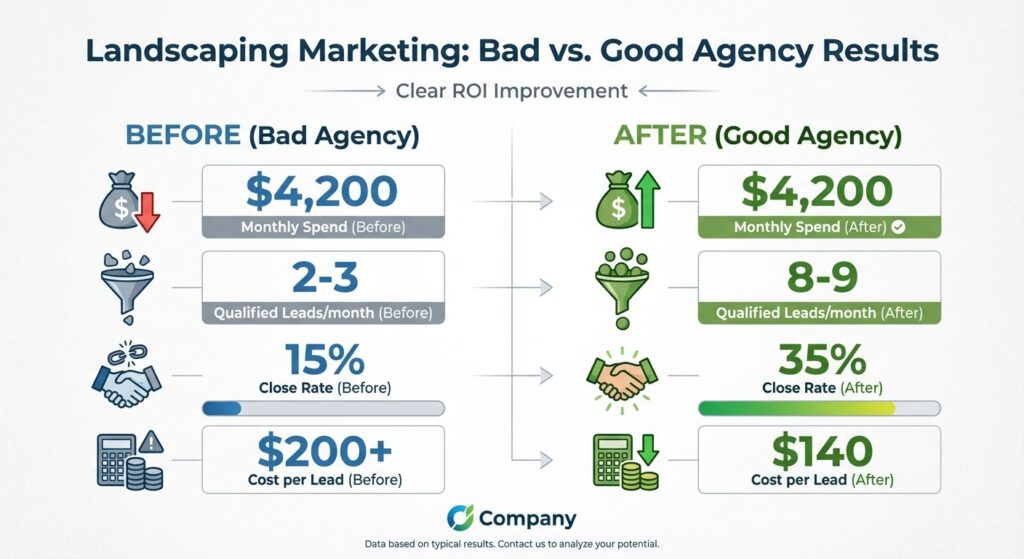
They were spending $4,200 a month and getting 15 to 20 leads per month, but the owner estimated only two or three were serious inquiries—the rest were homeowners asking for one-time cleanups or lowball quotes on small jobs.
When we audited the account, the problems were obvious.
Before and After: A Side-by-Side Comparison
| Metric | Original Agency | New Agency |
|---|---|---|
| Monthly spend | $4,200 | $3,800 |
| Total leads per month | 15-20 | 10-12 |
| Qualified leads | 2-3 | 8-9 |
| Close rate | 15% | 35% |
| Cost per qualified lead | $200+ | $140 |
| New contracts (90 days) | 1 | 3 |
| Contract value (90 days) | ~$22,000 | $67,000 |
The Google Ads campaigns were targeting broad residential keywords like “landscaping near me” and “lawn care service,” even though the company’s bread-and-butter work was commercial maintenance contracts and high-end hardscape installations. The website had no dedicated pages for commercial services, and the Google Business Profile listed the primary category as “lawn care service” instead of “commercial landscaper.”
We switched to an agency that specialized in commercial landscaping marketing. They rebuilt the Google Ads account around exact-match keywords for commercial services, created dedicated landing pages for each service line with project galleries and client testimonials, and optimized the Google Business Profile with the correct categories and weekly posts showcasing completed commercial projects.
Within 90 days, the lead volume dropped to 10 to 12 per month, but eight or nine were qualified commercial inquiries. The close rate jumped from 15% to 35%, and the owner signed three new maintenance contracts worth a combined $67,000 annually. The cost per qualified lead went from over $200 to around $140.
That’s what happens when an agency understands the business model and executes with precision.
Questions to Ask and Red Flags to Watch For
When you’re vetting agencies, here are the questions that separate the serious from the sales-focused:
Can you show me a case study from a landscaping company with a similar service mix and revenue range?
If they can’t, they’re experimenting on your budget.
What tracking and reporting tools will you use, and will I have direct access to the dashboards?
If they say “we’ll send monthly reports,” push for real-time access.
How do you define a qualified lead for my business, and how will we track lead quality?
If they don’t ask about your sales process, average contract value, or close rate, they’re not thinking about ROI.
What’s your process for optimizing underperforming campaigns, and how quickly do you make adjustments?
If they say “we review monthly and make changes quarterly,” that’s too slow. Industry reports confirm that 52% of businesses report rising material costs and 51% cite staffing as a concern, which means you can’t afford to waste months on campaigns that aren’t working.
What happens if I’m not seeing results after 90 days?
A good agency will have a clear answer: we’ll review the data, adjust the strategy, and if we still can’t deliver, we’ll part ways without penalty.
Red Flags That Should End the Conversation
- Agencies that guarantee specific rankings or lead volumes
- Agencies that won’t share login credentials to your Google Ads or Analytics accounts
- Agencies that require 12-month contracts with no performance benchmarks
- Agencies that deflect questions about past client results with vague language about “proprietary strategies”
Your Next Step: Audit Before You Hire
If you’re considering hiring an agency or evaluating your current one, start with an audit of what you have now.
Pull your Google Analytics data for the past six months and look at traffic sources, bounce rates, and goal completions. Export your Google Ads performance by campaign and calculate your cost per lead. Review your Google Business Profile insights to see how many calls and direction requests you’re getting. Check your website’s mobile speed using Google’s PageSpeed Insights tool.
That audit will give you a baseline, and it’ll help you ask better questions when you talk to agencies.
For a deeper look at agencies that have proven track records in the landscaping space, I’ve reviewed several options in detail at best landscaping marketing agencies. The right agency won’t just take your money and send reports—they’ll ask hard questions, show you proof of past results, and build a program that ties directly to the work you want to win.
Anything less is a waste of your time and your margins.