
How Smart Home Builders Are Landing More Clients: Marketing Strategies Worth Stealing
Last month I walked a builder through his Google Analytics. He’d spent $4,200 on Facebook ads, boosted every post about his model homes, and hired a “social media expert” who promised engagement.
The result? Seventeen form fills. Three callbacks. Zero contracts.
When I asked what his competitor down the street was doing differently, he went quiet. Then: “They’re not even running ads. But somehow they closed four homes last quarter—including a buyer who ghosted us after our first meeting.”
I see this pattern everywhere. Builders chase the loudest marketing advice—boost posts, run Google ads, “go viral”—while the actual pipeline math stays broken. The real gap isn’t effort. It’s that most home builder marketing treats every tactic like it’s equal, when the truth is simpler: positioning, proof, and local intent beat volume every time.
If you’re tired of tire-kickers and wondering which leads are real, here’s what I’ve seen work in 2026—not because it’s trendy, but because it fixes the actual breakdown.
Why “We Tried Everything” Usually Means “We Skipped the Foundation”
Most builders I audit tell me they’ve tried social media, Google ads, maybe even SEO. When I dig in, the pattern is identical: they’re promoting features to an undefined audience, with no clear reason a buyer should choose them over the builder two miles away.
The mistake isn’t the channel. It’s launching tactics before you’ve answered: Who are we for? and Why us instead of them?
The Persona Problem Nobody Wants to Admit
I worked with a semi-custom builder in North Carolina who was convinced his problem was ad spend. He’d been running generic “New Homes Available” campaigns on Facebook for eight months. Cost per lead looked decent—$47—but conversion to appointment sat at 4%.
When I asked him to describe his ideal buyer, he said, “Families who want quality.”
That’s not a persona. That’s a wish.
We paused the ads and interviewed his last six closed clients, mapping three distinct buyer types:
- Young professionals prioritizing commute time and modern finishes
- Growing families chasing school districts and outdoor space
- Empty-nesters downsizing but unwilling to sacrifice craftsmanship
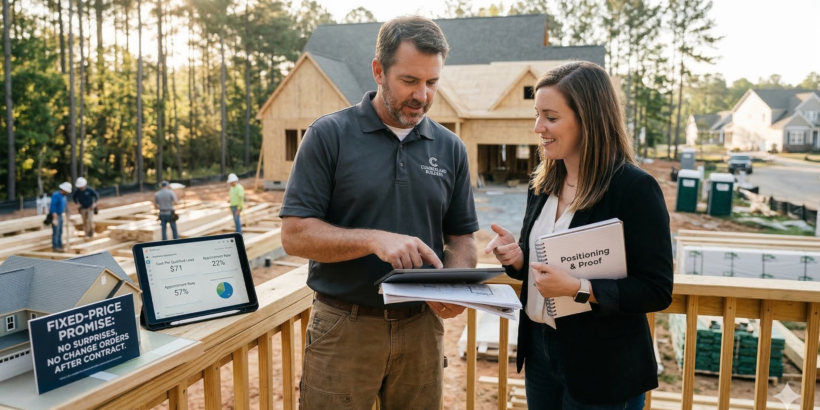
Once we rebuilt his messaging around those personas and tailored his landing pages, ad creative, and follow-up sequences to match, his cost per qualified lead rose to $71, but his appointment rate jumped to 22% and his close rate doubled. He wasn’t spending more. He was spending smarter.
The Brand Positioning Trap
Your brand isn’t your logo and tagline. It’s the mental shortcut a buyer uses when they’re comparing you to three other options at 11 p.m. on their phone.
If your positioning is “quality craftsmanship” or “trusted local builder,” you’re invisible. Real positioning answers: What do we do differently that matters to this specific buyer?
One of my clients in Tennessee was stuck in the middle—not the cheapest spec home option, not the luxury custom tier. His website said “Affordable Excellence.” When a buyer landed on his site after Googling “new homes near [suburb],” there was no reason to call him first.
We rebuilt his positioning around a single insight: his target persona—first-time move-up buyers—was terrified of hidden costs and change orders. His competitors talked about design flexibility. He started leading with “Fixed-Price Promise: No Surprises, No Change Orders After Contract.”
Within sixty days, his inquiry-to-appointment rate improved by 31%. Buyers who called were pre-qualified by the message itself. That’s what positioning does when you get it right.
Local Intent Is Where Buyers Actually Start—And Where Most Builders Lose Them
The buyer who Googles “new homes in [your city]” or “custom home builders near me” is worth ten times the buyer who clicked a boosted Facebook post. One has intent. The other has curiosity.
The problem is most builders treat local SEO and their Google Business Profile like afterthoughts. Meanwhile, their competitor—who isn’t spending a dime on ads—is ranking higher, showing up in the map pack, and capturing buyers at the exact moment they’re ready to move.
Why Google Business Profile Beats Paid Ads for Local Builders
I audited a builder in Georgia last year who was spending $2,800 a month on Google Search ads. His Google Business Profile had eleven reviews (three of them one-star complaints from 2019), six photos, and his hours listed as “permanently closed.”
A buyer searching “home builders in [his county]” saw his competitor’s profile first—48 reviews averaging 4.7 stars, virtual tour linked, recent photos, and posts highlighting a new neighborhood. My client’s ad appeared below the map pack. He was paying to be less visible than his free competitor.
What we fixed in one afternoon:
| Element | Before | After |
|---|---|---|
| Reviews | 11 total, 3 negative unanswered | All reviews responded to professionally |
| Photos | 6 outdated exteriors | 20 new photos (exteriors, interiors, in-progress) |
| Posts | None | Weekly updates on listings and design tips |
| Business Info | Incorrect hours, unverified | Fully verified and accurate |
Within thirty days, his profile started appearing in the local map pack. His organic lead volume doubled. His ad spend dropped by 40% because he wasn’t compensating for a broken free channel anymore.
The SEO Strategy That Actually Works for Builders
Forget trying to rank for “best home builder in America.” You’ll never outrank the national directories. Instead, own the hyper-local, high-intent searches: “[your city] custom home builders,” “new construction homes in [neighborhood],” “semi-custom builders near [landmark].”
The tactic that moves the needle fastest: neighborhood-specific landing pages.
One page per community you build in, optimized for “[neighborhood] new homes.” Include local details—school districts, commute times, nearby amenities. Add testimonials from buyers in that neighborhood. Link to available lots or recent builds.
A builder I worked with in Arizona created eight neighborhood pages over two months. Within ninety days, five of those pages ranked in the top three for their primary keyword. His organic traffic from local searches increased 140%, and his cost per lead from SEO was $19 compared to $68 from paid ads.
Content That Answers Real Questions
Write about the questions buyers ask you on sales calls:
- “How long does it take to build a custom home in [your market]?”
- “What’s the difference between spec and semi-custom?”
- “How do I choose a lot?”
Those are high-intent searches. If you answer them clearly and rank for them, you’re capturing buyers earlier in their journey—and positioning yourself as the expert before they ever call a competitor.
Proof Assets: Why Virtual Tours and Testimonials Close Deals Ads Can’t
Most buyers don’t trust builder marketing. They’ve been burned by overpromises, stock photos that don’t match reality, and identical sales pitches.
The antidote isn’t better copywriting. It’s proof. And in 2026, proof means two things: virtual tours that let buyers experience your work before they visit, and customer testimonials that validate your claims with real voices.
Virtual Tours Aren’t Optional Anymore
According to recent real estate research, buyers expect to walk through homes digitally before they waste a Saturday driving to a model.
I worked with a spec builder in Colorado who resisted virtual tours. His competitor added Matterport tours to every listing. Within two months, my client’s traffic dropped 18% and his appointment requests fell by a third.
We added virtual tours to his three active spec homes. His appointment-to-contract rate jumped from 11% to 27% because buyers who scheduled visits had already walked the home virtually and were coming in ready to talk numbers.
The cost? $150 per home for a freelance photographer with a 360 camera. The ROI? He closed two additional contracts in the next sixty days that he attributed directly to buyers who toured virtually first.
Customer Testimonials: The Proof That Overcomes Skepticism
Every builder says they deliver quality. Every builder claims they’re responsive and reliable. Buyers have heard it all before. The only voice they trust is another buyer who’s already been through the process.
Real testimonials are:
- Specific – They address exact objections your buyers have
- Recent – Collected within the last 12 months
- Strategically placed – Featured where decisions happen, not hidden in footers
One of my clients in Florida interviewed his last ten clients and asked them to describe their biggest fear before signing the contract. He turned those interviews into video testimonials and placed them on the pages where buyers were making decisions: the homepage, the “Why Choose Us” page, and individual neighborhood landing pages.
His inquiry-to-appointment conversion rate improved by 19%. When his sales coordinator asked new leads what convinced them to call, four out of ten mentioned the testimonials.
The tactical move: collect testimonials immediately after closing, while the experience is fresh. Ask specific questions that draw out the details you need. And don’t hide them—feature them everywhere a buyer is evaluating whether to trust you.
Social Media Platforms: Stop Broadcasting, Start Connecting
Most builders waste money treating social media like a billboard. They post photos of finished homes, announce new listings, share generic design tips, and wonder why engagement is flat and leads are nonexistent.
Social media works for builders when you use it to build relationships and demonstrate expertise—not to interrupt people with ads.
The Channel Comparison That Matters
Not all platforms are equal for home builders. Here’s what I’ve seen work:
| Platform | Best For | Strategy That Works | What Doesn’t Work |
|---|---|---|---|
| Local builders targeting families and move-up buyers | Community engagement in local groups + targeted persona-specific ads | Generic “New Homes Available” posts | |
| Younger buyers (under 40), visually distinctive homes | Consistent process documentation, behind-the-scenes content | Sales-heavy captions, irregular posting | |
| YouTube | High-intent buyers researching the process | Educational videos answering common questions | Overproduced promotional content |
| High-net-worth or commercial clients only | Professional thought leadership | Residential home promotion |
Pick one or two platforms where your buyer personas actually spend time, commit to consistent presence (weekly is fine), and focus on being useful instead of promotional.
The Content Strategy That Builds Trust
Stop posting finished homes with captions like “Another beautiful build!”
Start sharing the process. Show the framing stage. Explain why you chose a specific foundation approach for a challenging lot. Walk through a design decision and the trade-offs involved.
Real example: A builder in Virginia started posting short videos (60-90 seconds) every week explaining one aspect of the building process: how to read a site plan, what to look for in a lot, how to evaluate a builder’s warranty.
He wasn’t selling. He was teaching.
Within six months, his lead quality skyrocketed. Buyers who contacted him were pre-educated, asked smarter questions, and closed faster because they already trusted his expertise.
That’s the shift: from broadcasting your work to demonstrating your knowledge.
The System That Ties It All Together
Your marketing needs to work like a funnel, not a scatter plot.
Top of funnel: You’re capturing attention through local SEO, Google Business Profile optimization, and strategic social media presence. Buyers find you when they search for solutions or scroll through relevant content.
Middle of funnel: You’re building trust through proof assets—virtual tours, testimonials, and content that demonstrates your expertise. This is where you separate yourself from competitors who only talk about features.
Bottom of funnel: You’re converting interest into action through clear positioning, strong follow-up, and a sales process that feels consultative instead of pushy.
The builders who win in 2026 aren’t the ones spending the most on ads. They’re the ones who’ve built a system where every piece reinforces the others.
What to Do This Week
If you’re feeling behind or overwhelmed, start here:
Day 1: Audit your Google Business Profile today. Update photos, respond to reviews, verify your information, and post about an active listing or recent project.
Day 2-3: Interview your last three closed clients. Ask them what their biggest fear was before signing, what almost made them choose someone else, and what convinced them you were the right builder. Turn those answers into testimonials and positioning language.
Day 4-5: Create one piece of content that answers a real buyer question. A blog post, a video, a social media post—doesn’t matter. Just make it useful and specific to your market.
You don’t need to overhaul everything at once. You need to stop guessing and start building a system that captures buyers where they’re already looking, proves you’re worth trusting, and converts interest into contracts.