Roofing Companies That Depend on Referrals Stay Stuck—and Here’s the Way Out
I’m going to tell you something you probably already know but haven’t said out loud: if your phone only rings when someone’s uncle remembers your name or a storm rolls through, you don’t own a business—you’re renting one from luck.
I ran production for years before I bought my own shop. Back then, I thought referrals were the gold standard—proof you did good work. And they are. But when I took over a 12-person crew and watched two blue-sky quarters nearly sink us, I realized referrals are a ceiling, not a foundation.
The competitors with worse craftsmanship but cleaner Google profiles were eating our lunch.
This isn’t a rant against word-of-mouth. It’s a playbook for operators who keep seeing the same pattern: “ads don’t work in my town,” “SEO takes forever,” “I got burned by an agency.” If that’s you, I’ve been there. And I’m going to walk you through the field-tested moves that got us off the referral treadmill.
The Myth That Keeps You Stuck
The biggest lie in our trade isn’t that referrals don’t work—it’s that only referrals prove you’re legit.
I believed that for years. Then I watched a competitor with half our experience outrank us on Google, pull more inspection requests, and hire two crews while we scrambled to keep one busy. His work wasn’t better. His visibility was.
Why Multi-Channel Lead Generation Isn’t Hype—It’s Survival
Here’s the framework that changed how I think about growth: referrals are your base, but they’re reactive. Someone has to remember you, need a roof, and feel motivated to call—all at the same time.
That’s three variables you can’t control.
A real lead system gives you proactive channels that work even when your phone isn’t ringing. Think of it like this: referrals are your starting lineup. But if that’s your only lineup, one injury and you’re done. Multi-channel marketing is your bench.
The market backs this up. Industry forecasts show the roofing sector growing steadily, but that growth isn’t evenly distributed—it’s going to operators who show up where homeowners are actually looking.
Google. Reviews. Facebook groups.
Not the Yellow Pages.
The Three-Pillar System
| Pillar | What It Is | Why It Matters |
|---|---|---|
| Owned Visibility | Your Google Business Profile, website, review count | Assets you control that work 24/7 |
| Earned Trust | Reviews, case studies, before-and-after photos | Social proof that accelerates sales |
| Paid Reach | Google Local Service Ads, Facebook lead forms | Fills your pipeline when referrals slow down |
Each pillar feeds the others. A strong Google profile makes your ads cheaper. Good reviews make your sales process faster. Paid ads fill gaps.
Step One: Fix Your Google Business Profile Before You Spend a Dollar Anywhere Else
If I could force every roofing owner to do one thing tomorrow, it would be this: claim, verify, and optimize your Google Business Profile.
Not because it’s sexy—because it’s the highest-ROI move you can make with zero ad spend.
When someone in your town Googles “roofer near me,” Google shows a map pack with three businesses. If you’re not in that pack, you’re invisible. The difference between showing up third versus not at all can be 15–20 inspection requests a month.
Your GBP Optimization Checklist
- Verify your listing. Go to google.com/business, claim your profile, and complete verification.
- Fill out every field. Business name, address, phone number (match your website exactly). Service area. Hours. Categories: pick “roofing contractor” as primary, then add “roof repair service,” “gutter cleaning,” whatever you do.
- Add photos every week. Completed projects, your truck with your logo, your crew on-site. Google prioritizes profiles with fresh content. I upload three photos from the previous week’s jobs every Monday. Takes five minutes.
- Post updates. Google lets you create short posts—think of them as mini-ads. “Just completed a storm-damage roof in [neighborhood]. Free inspections this week.” Post once a week.
- Enable messaging. Let people text you directly from your profile. We get 4–5 inspection requests a month this way.
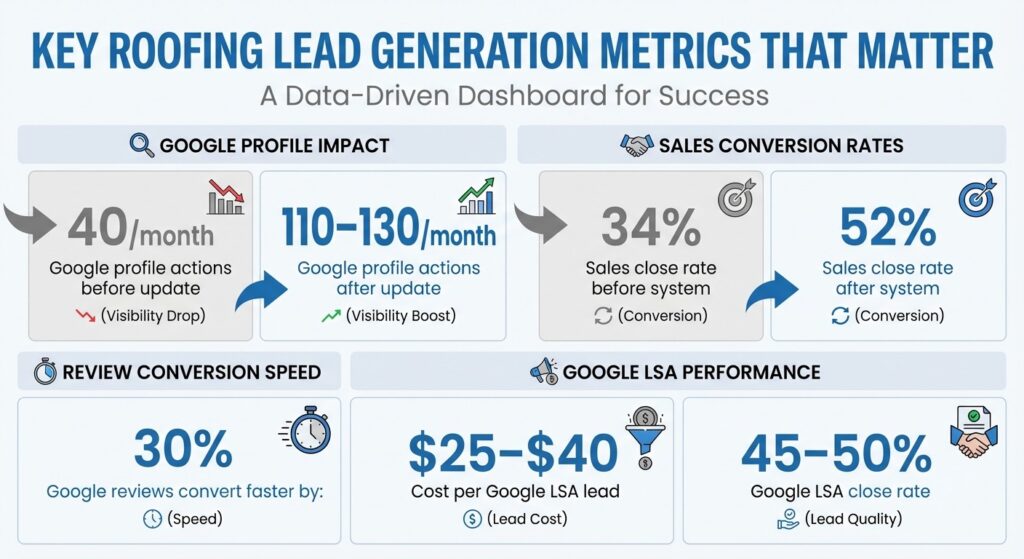
I tracked this obsessively. Before optimization, our profile got maybe 40 actions a month. After two months of consistent updates and photos, we averaged 110–130.
That’s steady, compounding visibility. And it cost us nothing but time.
For a deeper breakdown on how to grow a roofing company through digital channels, there are tactical guides that walk through the full local SEO stack—but start with GBP.
Step Two: Build a Review System That Runs Without You
Here’s the uncomfortable truth: most homeowners trust online reviews more than they trust a referral from a neighbor they barely know.
When I started tracking where our leads came from, the pattern was clear—prospects who saw 40+ Google reviews with recent dates closed 30% faster than cold referrals.
The problem? Asking for reviews feels awkward. So most operators don’t ask, or they ask inconsistently.
I fixed this by making review requests automatic:
Pick your timing. We ask 48 hours after final payment clears, when the client is happy but the project is still fresh.
Use a simple script. I text or email: “Hey [Name], thanks again for trusting us with your roof. If you’re happy with how it turned out, would you mind leaving a quick review on Google? Here’s the link: [direct review link]. Takes 60 seconds and helps us keep our crews working.”
Track your velocity. I keep a spreadsheet: project completion date, review request sent, review received. If we’re under 30% conversion, I tweak the message or timing. Right now we’re at 38%, which means if we close 20 jobs a quarter, we’re adding 7–8 fresh reviews.
One more thing: respond to every review, good or bad. Google rewards engagement, and prospects notice when you care.
Step Three: Implement a Sales Process That Doesn’t Depend on Your Gut
This is where most referral-dependent operators lose deals without realizing it. You get a lead, you show up, you quote, and then… silence.
I used to think that was just part of the game. Then I started tracking our close rate (it was 34%) and realized competitors with worse reputations were closing 50–60%.
The difference wasn’t price or quality—it was process.
Your Four-Stage Sales Framework
Stage one: Qualify the lead fast. When someone calls, ask three questions within 60 seconds:
- Is this an insurance claim or out-of-pocket?
- What’s your timeline?
- Have you gotten other quotes?
This tells me if they’re serious or just kicking tires.
Stage two: Inspect and educate, don’t just quote. On-site, I take photos, walk them through what I see, and explain options. I send a follow-up email with those photos, a written summary, and the quote. This builds trust and gives them something to reference when comparing bids.
Stage three: Follow up in 48 hours. I text or call two days later: “Hey [Name], just checking in—any questions about the estimate?” That one follow-up closes 15–20% of deals that would’ve gone cold.
Stage four: Stay in touch even if they don’t buy. If they go with someone else or delay, I check in every 90 days. I’ve booked jobs 6–8 months later this way.
This isn’t high-pressure sales. It’s structured follow-through. And it turned our close rate from 34% to 52% in one season.
Step Four: Use a CRM to Stop Losing Leads in the Cracks
I resisted CRMs for years because I thought they were overkill. Then I realized I was losing 10–15 leads a quarter just because I forgot to follow up.
A CRM is just a place to track every lead so nothing falls through the cracks. You don’t need Salesforce. I use a simple tool (there are roofing-specific ones, or you can start with HubSpot’s free tier or a Google Sheet with reminders).
What My CRM Tracks
- Lead source (GBP, referral, ad, door-knock)
- Contact info and project type
- Stage (new lead, quoted, follow-up scheduled, won, lost)
- Next action and due date
Every Monday, I review the pipeline. This takes 20 minutes a week and has added $40K–$60K in closed jobs annually.
The other benefit: I can see which lead sources actually convert. Our Google Local Service Ads close at 48%, door-knocking at 22%, and Facebook leads at 18%. That data tells me where to double down.
Comparing Lead Channels: What Works, What’s Overrated
Once you’ve got the foundation, you can start testing paid and partnership channels. But here’s the reality: not every channel works in every market, and most take 60–90 days to show ROI.
| Channel | Cost Per Lead | Close Rate | Best For | Reality Check |
|---|---|---|---|---|
| Google Local Service Ads | $25–$40 | 45–50% | Metro areas with high search volume | Need clean record; Google vets you |
| Facebook Lead Ads | $8–$15 | 15–20% | Brand awareness, filling slow months | Lower intent—people aren’t actively searching |
| Door-to-Door (Storm Zones) | Labor only | 20–25% | Building initial customer base | Labor-intensive; timing is everything |
| Agent Partnerships | Free | 60%+ | Long-term relationship building | Takes 6–12 months to see traction |
| SEO (Organic) | Time investment | N/A | Patient operators | Took us a year; now 4–6 leads/month at zero cost |
The key is to run 2–3 channels at once so you’re not dependent on any single source.
Your First 90-Day Growth Sprint
If you don’t know where to start, here’s the exact 90-day plan I’d run:
Days 1–30: Foundation
Claim and optimize your Google Business Profile. Set up a review request system. Start tracking leads in a spreadsheet—source, stage, outcome.
Days 31–60: Process
Write down your sales process. Implement 48-hour follow-ups on every quote. Set up a simple CRM or upgrade your spreadsheet with next-action dates.
Days 61–90: Expand
Turn on one paid channel—LSAs if you’re in a metro, Facebook if you’re in a smaller town. Budget $500–$1,000 to test. Track cost per lead and close rate. If it’s profitable, scale.
At the end of 90 days, you should have: a Google profile pulling 80–100 actions a month, 10–15 new reviews, a documented sales process, and data on at least one paid channel.
When Growth Stalls: Your Troubleshooting Guide
Even with a solid system, you’ll hit plateaus. Here’s how I troubleshoot:
Q: My GBP traffic dropped. What’s wrong?
A: Check your photo and post frequency. Google rewards fresh content. Also, search your business name and make sure your NAP (name, address, phone) is consistent across directories.
Q: My close rate is slipping. Where do I look?
A: Review your last 10 lost deals. What was the objection? Price? Timeline? Trust? Adjust your process accordingly.
Q: A lead channel stopped working. Should I kill it?
A: Don’t panic. Test a new audience, tweak your ad copy, or pause for 30 days and restart. Markets shift.
Q: I’m overwhelmed. What gives?
A: Hire help before you think you need it. I waited too long to bring on an office manager. Once I did, my close rate jumped because I wasn’t juggling admin and sales.
Look, I’m not going to tell you this is easy or that you’ll 10X your revenue in six months.
The operators I see succeed treat growth like production work—methodical, consistent, no shortcuts. You wouldn’t skip flashing on a roof and hope for the best. Don’t skip the boring marketing fundamentals and hope referrals carry you forever.
The roofing market is growing—recent data shows steady expansion—but that growth is going to the operators who show up where customers are looking.
If you’re still waiting for the phone to ring, you’re not competing. You’re hoping.
Start with your Google profile this week. Ask for three reviews this month. Track your leads in a spreadsheet. That’s it. No agency, no five-figure ad budget, no magic bullet. Just the unglamorous work that turns a referral-dependent crew into a lead-generating machine.
You’ve got the skills. Now build the system.