

How Construction Companies Are Winning More Contracts: Marketing Ideas That Actually Deliver
I spent my first three years in construction as a project engineer, convinced that marketing was something other industries did. Good work spoke for itself, right?
Then I watched a concrete sub I respected lose two anchor clients in one quarter—not because of quality issues, but because a competitor had simply stayed more visible. That’s when I started paying attention to how firms actually win work, and it wasn’t just through handshakes anymore.
Now I help regional subcontractors and GCs build lead systems that don’t require a marketing degree or a six-figure agency retainer. Every week, I get calls from owners saying the same thing: “Referrals dried up,” or “I tried Google Ads and got nothing but tire-kickers.” The frustration is real, and so is the skepticism. Most marketing advice is generic, built for e-commerce or SaaS, not for the way construction buyers actually choose who to work with.
This isn’t going to be a pitch for some magic funnel. Instead, I’m walking you through a step-by-step marketing plan that fits the construction sales cycle—and shows you exactly how to track leads, conversion rates, and backlog impact so you can prove ROI to your partners.
Why Most Construction Marketing Advice Falls Flat (And What Actually Works)
The biggest mistake I see is treating construction marketing like B2C retail.
Agencies push Facebook ads with flashy creative, or SEO firms promise page-one rankings without understanding that most GCs and owners aren’t Googling “best concrete contractor near me” when they’re filling out a bid list. They’re checking references, reviewing past projects, and asking, “Can this firm handle our schedule and scope?”
Here’s the reality: construction buying decisions are long, relationship-heavy, and driven by proof of capability. Your marketing plan has to mirror that. It’s not about going viral or generating thousands of clicks. It’s about being findable when someone’s vetting you, demonstrating competence through your project portfolio, and staying top-of-mind during the months-long gap between first contact and contract signature.
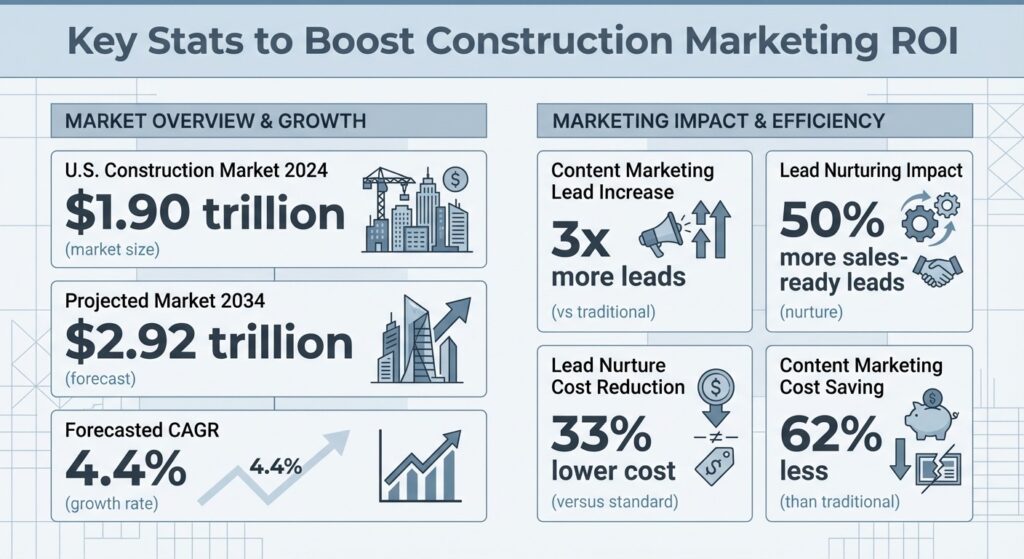
The industry is expanding, with the U.S. construction market reaching approximately $1.90 trillion in 2024. Firms with clear positioning and consistent visibility are capturing more of that pie, while others are stuck waiting for the phone to ring.
Start With Who You’re Actually Targeting (Not “Everyone Who Needs Construction”)
Before you touch your website or write a single ad, you need a buyer persona.
Here’s what it means in practice: who is the person who decides whether you get invited to bid, and what do they care about?
For a commercial GC, that might be a project manager at a developer who’s juggling five active builds and needs a sub who won’t blow the schedule. For a specialty trade, it could be a facilities director at a hospital system who values compliance documentation and after-hours availability.
Building Your Buyer Persona: Four Essential Elements
| Element | What to Define | Why It Matters |
|---|---|---|
| Role and Responsibility | Are they the final decision-maker, or do they recommend to someone else? | A project engineer might vet you, but the VP of preconstruction signs the contract |
| Project Type and Scale | Do they run $500K tenant improvements or $50M ground-up builds? | Your portfolio and messaging need to match their scope |
| Evaluation Criteria | What do they check first—safety record, bonding capacity, specialty certifications, or speed of response? | Focus on what actually drives their decision |
| Information Sources | Where do they look when vetting firms? | Some check LinkedIn, others rely on AGC directories or ask their estimating team |
Once you’ve mapped this out, every piece of your marketing plan—from your website copy to your project case studies—should answer the questions this specific buyer is asking.
How Your Website Either Converts Leads or Loses Them in 30 Seconds
Most construction company websites are digital brochures: a homepage with a crane photo, an “About Us” page, and a “Contact” form buried three clicks deep.
That’s not a lead-generation tool—it’s a placeholder.
When someone lands on your site, they’re asking three questions: Can you do this type of work? Have you done it before? How do I get in touch? Your website needs to answer all three above the fold.
Homepage clarity: Lead with your core capability and service area. “Commercial concrete for mid-rise projects in the Southeast” tells me more than “Building the future, one project at a time.” Include a clear call-to-action—”Request a Bid” or “View Our Portfolio”—that’s visible without scrolling.
Project portfolio as proof: This is your most valuable marketing asset. Show the challenge (tight schedule, complex phasing, specialty materials), your approach, and the result. Include photos that demonstrate scale and quality. One electrical sub I work with added a “Projects by Sector” filter (healthcare, education, industrial), and their portfolio page became their second-highest traffic source.
Service pages for SEO: Each major service should have its own page with detailed descriptions, relevant keywords, and examples. If you do both new construction and renovations, those need separate pages. This is where organic search starts to work—when someone Googles “structural steel fabricator in Charlotte,” your service page should rank.
Conversion paths: Every page should have a next step—a contact form, a phone number (click-to-call on mobile), or a downloadable project profile. Keep forms simple: name, email, project type, and message.
Your website is your 24/7 sales rep. When a GC is comparing three subs at 9 PM before a bid deadline, the one with the clearest capability statement and easiest contact method usually gets the call.
The Digital Marketing Tactics That Fit Construction Sales Cycles
Digital marketing for construction isn’t about trending on TikTok. It’s about being discoverable during the research phase and staying visible during the long decision cycle.
SEO: Organic Search as a Long-Term Lead Source
Search engine optimization gets a bad rap because agencies oversell it, but when done right, it’s one of the most cost-effective lead sources. The key is targeting the right keywords—not high-volume generic terms, but specific phrases that match how your buyers search.
A mechanical contractor shouldn’t just target “HVAC services.” They should target “commercial HVAC installation for healthcare facilities” or “industrial ventilation retrofit.” These longer-tail keywords have lower search volume but much higher intent.
Start by auditing your competitors’ websites. Use a tool like Ahrefs or Semrush to see what keywords they rank for. Look for gaps—services they offer that you do better, or locations they don’t cover. Then build or optimize pages around those opportunities.
Content marketing supports SEO, and research shows it can bring three times more leads than traditional methods while costing 62% less. That doesn’t mean you need a blog with daily posts. It means creating useful resources that answer your buyers’ questions: project case studies, technical guides, or FAQs about permitting, scheduling, or material selection.
Paid Search: When You Need Leads Now
Google Ads can work for construction, but only if you’re strategic.
Broad campaigns targeting “construction company” will burn through budget fast. Instead, focus on high-intent keywords tied to specific services and locations: “concrete foundation repair in [city]” or “commercial roofing replacement [region].”
Set a modest daily budget—$30 to $50 is enough to test—and use negative keywords aggressively to filter out irrelevant searches (add terms like “jobs,” “careers,” “DIY”). Track every lead source so you know which keywords convert.
The real value of paid search is speed. SEO takes months to build momentum. Ads can start driving traffic this week.
LinkedIn for Relationship Building
LinkedIn isn’t just for posting company updates. It’s where project managers, owners, and procurement teams are active.
Your company page should showcase recent projects, certifications, and team expertise. Encourage your leadership and project managers to build their own profiles and engage with their networks. When someone’s vetting your firm, they’ll check LinkedIn.
For more tactical approaches to digital presence, explore marketing ideas for construction company strategies that align with how construction buyers evaluate potential partners.
Building a Lead Capture and Conversion System That Actually Works
Generating traffic is only half the equation. If your website gets 500 visitors a month but only two fill out a contact form, you have a conversion problem, not a traffic problem.
Five Lead Capture Mechanisms That Work
- Multiple contact options: Offer a “Request a Project Consultation” button, a downloadable capability statement in exchange for an email address, and a “Get a Quote” form that asks for project type, timeline, and budget range.
- Immediate response protocols: If someone submits a form on Tuesday and doesn’t hear back until Friday, they’ve already moved on. Set up email alerts and aim to respond within two hours during business hours.
- Strategic lead nurturing: Not every inquiry is ready to buy today. Data shows that companies mastering lead nurturing generate 50% more sales-ready leads at 33% lower cost.
- Automated follow-up sequences: Create a simple nurture sequence: an initial response with your capability statement, a follow-up a week later with relevant case studies, and a monthly check-in if they’re still researching.
- Clear sales handoff criteria: Define what qualifies as a “good lead” (right project type, realistic timeline, appropriate budget), and make sure your sales or estimating team knows how to handle them.
Tools like HubSpot (free tier) or even a well-organized spreadsheet can manage this. The goal is to stay top-of-mind without being pushy.
Competitor Analysis: Learning What’s Working Without Copying
You don’t need to reinvent the wheel. Your competitors are already running experiments—some successful, some not.
Start with a simple competitive audit. Identify three to five firms you compete against regularly. Analyze their website structure, SEO presence, advertising approach, and social media activity.
Their website: What services do they highlight? How’s their project portfolio organized? Is their site mobile-friendly and fast-loading?
Their SEO presence: What keywords do they rank for? Tools like Ahrefs or Semrush can show you their top-performing content. Look for gaps—topics they haven’t covered or locations they don’t emphasize.
Their advertising: Check Facebook Ad Library and LinkedIn to see if they’re running paid campaigns. What messaging are they using?
Their social media: How active are they on LinkedIn or Instagram? High engagement suggests they’ve found a format that works.
This isn’t about imitation—it’s about understanding the competitive landscape so you can differentiate. If everyone in your market emphasizes “quality craftsmanship,” that’s table stakes. Find the angle they’re missing: faster turnaround, specialized certifications, better safety record, or deeper expertise in a niche sector.
Tracking What Matters: How to Prove Marketing ROI Without a PhD in Analytics
Here’s where most construction marketing plans fall apart: no measurement.
Owners invest in a website redesign or run ads for three months, see some activity, but can’t connect it to actual revenue. Without proof, marketing becomes the first budget cut when cash gets tight.
You need three simple metrics tracked consistently.
The Three Metrics That Matter
| Metric | What to Track | Benchmark Target |
|---|---|---|
| Lead Source | Where did each inquiry come from? Website form, phone call, email, referral, trade show, LinkedIn message? | After 90 days, you’ll see patterns—maybe 40% from organic search, 30% from referrals, 20% from LinkedIn, 10% from paid ads |
| Conversion Rate | What percentage of leads turn into qualified opportunities, and what percentage turn into signed contracts? | 10-15% lead-to-opportunity rate and 30-40% opportunity-to-close rate are solid starting points |
| Cost Per Acquisition | If you’re spending $2,000/month on Google Ads and generating 10 leads, that’s $200 per lead | Compare to your margin to determine channel profitability |
Track this monthly. Set a baseline in month one, define a target (e.g., increase qualified leads by 25% in six months), and review progress every week.
Common Pitfalls and How to Avoid Them
Even with a solid plan, execution stumbles happen. Here are the traps I see most often:
Inconsistent follow-up: You launch a new website, get a spike in inquiries, then let them sit because you’re busy on active projects. Leads go cold fast. Assign someone to own lead response and make it part of the weekly routine.
Ignoring mobile users: Over half of web traffic is mobile now. If your website isn’t mobile-optimized—fast loading, easy navigation, click-to-call buttons—you’re losing leads before they even reach out.
Trying to do everything at once: Start with the fundamentals: a solid website, clear buyer persona, one or two lead sources (organic search and referrals, or LinkedIn and paid search), and consistent tracking. Once those are working, layer in additional channels.
Expecting instant results: Marketing in construction is a long game. SEO takes three to six months to show meaningful traffic. Set realistic timelines and measure progress in 90-day increments, not week-to-week.
Your Next Steps: Building the Plan This Month
You don’t need to overhaul everything overnight. Here’s a practical 30-day roadmap:
Week 1: Define your buyer persona. Write down who makes the decision, what they care about, and where they look for information. Audit your current website—does it answer their questions clearly?
Week 2: Set up lead tracking. Create a simple spreadsheet or CRM to log every inquiry with source, date, project type, and status. Start measuring your baseline conversion rate.
Week 3: Optimize your website for conversion. Add clear calls-to-action, improve your project portfolio with detailed case studies, and make sure your contact information is visible on every page.
Week 4: Launch one lead-generation tactic. That could be optimizing three service pages for SEO, starting a LinkedIn outreach campaign, or running a small Google Ads test. Track results weekly.
After 90 days, review what’s working. Double down on the channels driving qualified leads, cut what’s not, and add one new tactic.
The construction industry is growing, with projections showing the U.S. market reaching $2.92 trillion by 2034 at a 4.40% CAGR. Firms that build proactive lead systems now will capture a disproportionate share of that growth.
You don’t need a massive budget or a marketing team. You need clarity on who you’re targeting, a website that converts, one or two reliable lead sources, and a system to track what’s working.
Start small, measure everything, and adjust as you learn. That’s how you turn marketing from a gamble into a predictable growth engine.