
How Landscaping Businesses Go From Seasonal Hustle to Year-Round Growth
I keep seeing the same pattern in my inbox every late winter. A landscaper sends me their numbers: they were slammed April through June, went quiet in July and August, then panicked with 15% discounts in October.
The Google Ads bill shows $4,200 spent, but when I ask how many of those leads closed, I get a shrug. “Never saw most of them,” one owner told me last week. “The CRM was supposed to track it, but nobody had time to log calls during install season.”
The YouTube threads are full of this debate—SEO is too slow, Ads are a scam, younger homeowners only trust what they see on Google. But the real issue isn’t which channel wins. It’s that most crews are reacting to seasons instead of building a system that works across all twelve months.
The Myth That Keeps You Stuck
Most landscapers think they need to pick a lane: either become a social media content machine or dump money into Google Ads until something sticks.
I’ve watched operators burn through $8,000 in three months chasing clicks, then give up and say digital marketing doesn’t work for trades. Meanwhile, a smaller crew down the road is booking February consultations because they spent an hour a week on fundamentals.
The fix isn’t flashier tactics. It’s a repeatable pipeline: Google Business Profile that actually gets maintained, service pages that answer the questions homeowners type at 9 PM, a review system that runs without you begging, a referral program with real incentives, and CRM follow-up that doesn’t die in June.
The Year-Round Revenue Framework
Four Revenue Streams That Don’t Peak Together
I walked a client through this last fall. He ran a 12-person landscape crew, and his revenue chart looked like a heart-rate monitor—huge spikes in spring, flatline in late summer.
We built a framework around four revenue streams:
| Revenue Stream | Peak Season | Key Strategy |
|---|---|---|
| Core Maintenance Contracts | April-October | Monthly billing for predictable cash flow |
| Design-Build Projects | Winter booking, spring install | Collect deposits in January/February |
| Seasonal Services | Fall/Winter | Package fall cleanups, winter snow removal |
| Specialty Add-Ons | Year-round | Upsell during maintenance visits |
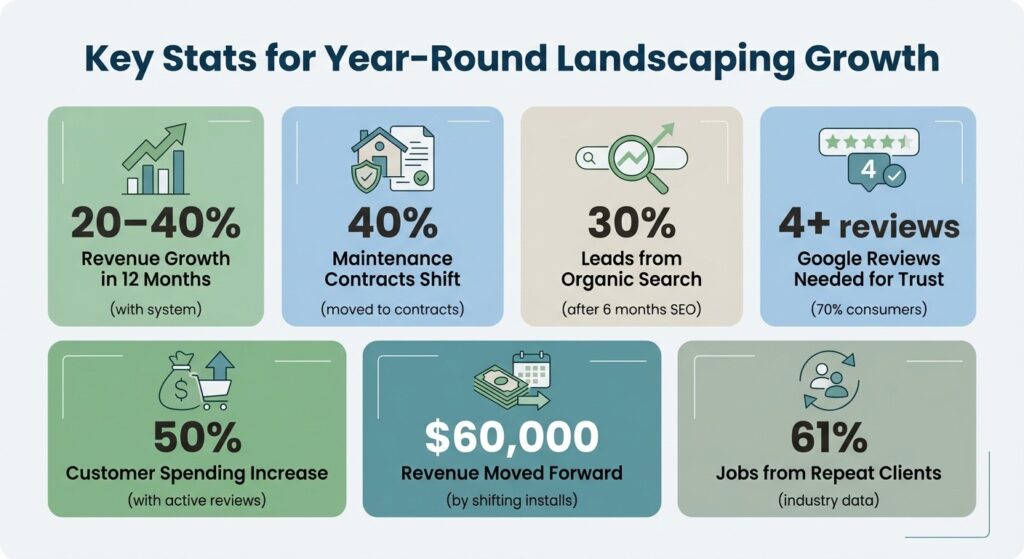
Core maintenance contracts became the base layer. He shifted 40% of residential clients to April-through-October agreements with monthly billing. That smoothed cash flow and gave the crew predictable routes.
Design-build projects started in winter. When a homeowner calls in March wanting a patio, most crews say “we’ll get to you in May.” He started booking design consultations in January and February, collecting deposits, and scheduling installs for late April. That moved $60,000 in revenue forward by eight weeks.
Seasonal services filled the gaps. Fall cleanups became a package marketed in August with early-bird pricing. Winter snow removal became a contract offering in October.
Specialty add-ons—outdoor lighting, irrigation audits, mulch refreshes—turned into upsells during maintenance visits instead of separate sales cycles.
The result: revenue spread across ten months instead of six, and the crew stayed busy enough to keep good people year-round.
Your Google Business Profile Is Your New Storefront
Here’s what I see when I audit a landscape company’s Google Business Profile: last photo uploaded nine months ago, business description says “we do landscaping,” hours listed as “call for availability,” and three reviews from 2021.
Then the owner wonders why the phone isn’t ringing.
The Non-Negotiable Basics
Business name, address, phone number need to match everywhere online—your website footer, your Facebook page, your invoice template. Google checks this.
Service area matters more than most crews realize. Don’t just list your town. Add every zip code you’ll drive to, because Google shows you to searchers in those areas.
The business description is where you translate what you do into what homeowners search for. Don’t write “Smith Landscaping provides quality service.” Write “We install patios, retaining walls, and outdoor kitchens in [your county], and handle weekly mowing, mulching, and seasonal cleanups for residential properties.”
Those are the phrases people type. Use them.
The Weekly Maintenance That Compounds
Photos and posts are the ongoing maintenance. I have clients upload three photos every week—a finished project, a crew shot, a before-and-after. It takes ten minutes.
Google rewards fresh content with better visibility. Posts work the same way: share a spring cleanup special in February, a patio install in May, a fall planting guide in September.
One operator I work with started posting weekly in January. By April, his GBP was showing up in the top three results for “landscape design [his town],” and he tracked eleven calls directly from people who said they saw his recent project photos.
Local SEO: The Long Game That Pays Every Month
SEO frustrates landscape owners because it doesn’t work like an ad—you can’t turn it on Friday and get calls Monday.
But once it’s running, it delivers leads without ongoing spend. I’ve seen crews get 30% of their inquiries from organic search after six months of consistent work.
Service Pages: Your Digital Sales Team
Most landscape websites have a generic “Services” page that lists everything. That doesn’t rank.
You need separate pages for each major offering:
- “Patio Installation in [Your Town]”
- “Weekly Lawn Maintenance [Your County]”
- “Landscape Design Services [Your Area]”
Each page should answer the questions homeowners ask: What does this cost? How long does it take? What’s included?
One client added a “Retaining Wall Installation” page with cost ranges, timeline expectations, and five project photos. Within three months, it was ranking on page one for “retaining wall contractor [his town],” and he closed four jobs directly from that page.
Keywords That Actually Matter
You’re not competing nationally for “landscaping”—you’re competing in your service area for “landscaper in [town]” or “patio installer near me.” Use those phrases in your page titles, headings, and naturally in your content.
The Technical Layer Most Crews Skip
Citations and backlinks are where the real ranking power lives. A citation is anywhere your business name, address, and phone number appear online—Yelp, Angi, local chamber of commerce directories.
Backlinks are when another site links to yours—a local blog mentions your work, a supplier lists you as a certified installer. Those links tell Google you’re a real, trusted business.
I worked with a crew that got a backlink from their town’s “Best Local Businesses” roundup. That single link moved them from page two to page one for their main keyword within a month.
Reviews: The Trust Engine That Drives Decisions
Consumer research shows that 70% of people need at least four reviews before they’ll trust a business.
I see landscape companies with two reviews from three years ago, and they’re losing jobs to competitors with twenty recent ones—even if the competitor’s work isn’t better.
The System That Runs Itself
After every completed job, send a follow-up text or email within 48 hours: “Thanks for trusting us with your patio. If you’re happy with the work, we’d appreciate a quick review on Google. Here’s the link: [direct review link].”
Make it easy. Don’t ask them to search for you.
Timing matters. Ask right after the install when they’re excited. One client started asking immediately and went from three reviews to thirty-two in six months.
How to Respond (Every Single Time)
Respond to every review, good or bad.
A five-star review deserves a thank-you: “Thanks, Jennifer—we loved working on your backyard. Let us know if you need anything down the road.”
A three-star review needs a professional response: “We appreciate the feedback and we’re sorry the timeline ran longer than expected. We’ve adjusted our scheduling process to prevent that. Please reach out if there’s anything we can do to make this right.”
Homeowners read your responses as much as the reviews themselves. Studies indicate that active review management can increase customer spending by 50%, because trust converts to bigger projects.
CRM and Referral Programs: Turning One Job Into Three
Here’s where most landscape crews lose money: a homeowner calls in April, you give them an estimate, they say they’ll think about it, and you never follow up.
Two months later, they hire someone else.
The Simplest CRM That Works
A CRM doesn’t have to be complicated. I’ve seen crews succeed with a simple spreadsheet that tracks:
- Lead name
- Phone number
- Service requested
- Estimate sent date
- Follow-up dates
- Status
The key is logging every lead the day it comes in and setting follow-up reminders.
The Follow-Up Sequence That Closes
Day 0: Send the estimate same-day or next-day.
Day 3: Text: “Hi [name], just checking if you had any questions about the patio estimate we sent over.”
Day 7: Call: “Wanted to see if you’d like to move forward or if there’s anything we can adjust.”
Day 14: Email with a case study or photo of a similar project.
Most leads don’t close on the first touch. They close on the third or fourth, but only if you stay consistent.
One client tracked this and found that 40% of his closed jobs came from leads that took two or more weeks to decide. He would have lost all of them if he’d stopped after the first email.
Referral Programs That Actually Drive Action
“Tell your friends” doesn’t drive action.
“$100 off your next service for every referral that books” does.
I’ve seen crews offer a spring cleanup discount, a free mulch refresh, or a gift card to a local restaurant. The key is promoting it—mention it when you finish a job, include it in your invoice, post it on your GBP.
Industry data confirms that 61% of landscape firms win new projects through repeat clients, which tells you that your existing customers are your best growth engine if you give them a reason to refer.
Social Media: Presence Without Becoming an Influencer
I get pushback on this one. “I’m not posting selfies with my truck.”
You don’t have to.
Social media for landscaping isn’t about personality—it’s about proof.
Three Content Types on Rotation
Project showcases: Before-and-after shots of a patio, a lawn transformation, a landscape bed you installed.
Seasonal tips: “Three things to do before winter” or “When to overseed your lawn.”
Team/community content: A crew photo, a local event you sponsored, a thank-you to a long-time client.
Consistency beats volume. Two posts a week is enough if you do it every week.
One client posts every Tuesday and Friday—a project photo on Tuesday, a tip or community post on Friday. He’s tracked at least six jobs that started with “I saw your post about retaining walls.”
When Paid Ads Make Sense
Paid ads on Facebook can work if you target tight: homeowners within ten miles, age 35-65, interests in home improvement or gardening.
A $200 monthly budget can generate 15-20 leads if your ad shows a strong project photo and a clear call-to-action: “Free patio design consultation—book now for spring install.”
Partnerships and Local Alliances: Borrowing Trust
Landscape work overlaps with other trades—hardscape suppliers, irrigation specialists, garden centers, real estate agents, property managers.
Those overlaps are referral opportunities if you build the relationships.
I worked with a crew that partnered with a local nursery. The nursery recommended them for installation jobs, and they sent plant-buying customers to the nursery. Both businesses won.
Another client built a relationship with a realtor who needed yard cleanups for listings. That turned into twelve jobs in one year, all pre-sold because the realtor vouched for the quality.
Make the Value Specific
The key is offering something specific: “We handle landscape installs for your clients who want outdoor upgrades before selling,” or “We provide maintenance packages for your rental properties.”
Community sponsorships work the same way. Sponsor a little league team, a local festival, a charity event. You’re building name recognition and goodwill.
Branding: Looking Like the Crew You Want to Become
Branding isn’t a logo.
It’s the impression you leave at every touchpoint—your truck wrap, your crew’s shirts, your invoice, your voicemail greeting, your Google Business Profile.
I’ve seen crews lose jobs because their truck had peeling decals and their estimate was a handwritten note on a torn piece of paper.
The Basics That Signal Professionalism
Invest in these fundamentals:
- Clean truck with your business name and phone number
- Matching crew shirts
- Printed estimates on branded paper or sent via email with a professional template
- A simple website that loads fast on mobile and shows your best work
You don’t need a $10,000 rebrand. You need consistency and polish.
One client upgraded his estimate template to include project timelines, payment terms, and three reference photos of similar work. His close rate went from 35% to 52% in four months.
The Objections I Hear and What Actually Happens
“This sounds like a lot of work.”
It is, up front. But once the system is running—GBP maintained, service pages live, review requests automated, CRM tracking leads, referral program promoted—it runs with an hour or two a week.
“SEO takes too long.”
It takes three to six months to see results, yes. But Google Ads stop the minute you stop paying. SEO keeps delivering.
I’d rather have both working together: Ads for immediate leads while SEO builds long-term visibility.
“We get enough work from word-of-mouth.”
Great. What happens when your best referral source retires, moves, or hires someone else?
Marketing for landscaping business isn’t about replacing referrals—it’s about adding a second engine so you’re not dependent on one source.
Start Here, This Week
The crews I work with that implement this framework—Google Business Profile, local SEO, reviews, CRM, referrals, targeted social, partnerships, and consistent branding—report 20-40% revenue growth within twelve months, with work spread more evenly across the year.
They’re not working harder. They’re working with a system that attracts the right leads, converts them reliably, and keeps them coming back.
Start with your Google Business Profile this week. Update your photos, rewrite your description with local keywords, and set a reminder to post twice a week.
That’s the foundation. Everything else builds from there.