
What Separates Stagnant HVAC Companies From the Ones That Actually Scale Their Business
I just wrapped an audit call with an HVAC owner who told me, “We’re getting leads—they’re just junk.” Then he admitted his office phone goes to voicemail after 4 PM and he doesn’t have a follow-up system for quotes.
This isn’t rare. I see this pattern every week: operators blaming lead quality when the real issue is they’re pouring water into a bucket with holes.
The YouTube comments tell the same story. Someone asks for “one marketing thing” to grow their HVAC business, and the replies flood in: run Google Ads, optimize your SEO, drop door hangers, post on Facebook. Nobody mentions that if you can’t answer calls in under 90 seconds or follow up on estimates within 24 hours, you’re just burning money. The market is growing steadily, but most shops stay stuck because they’re chasing tactics without the underlying system.
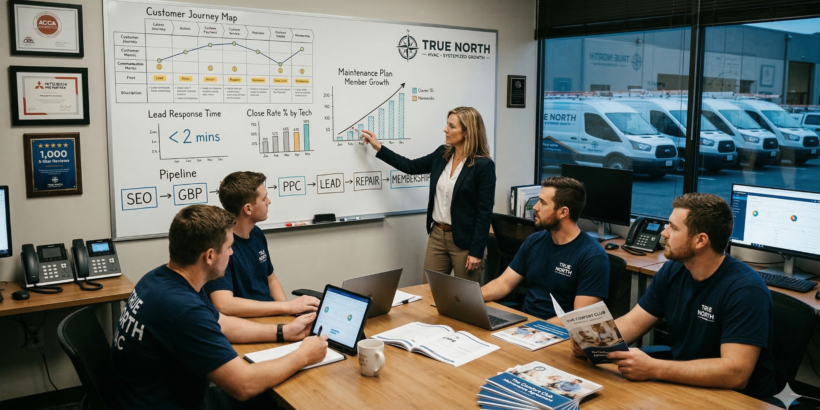
Here’s what I learned rebuilding HVAC pipelines: consistent lead generation isn’t about finding the magic channel. It’s about controlling four levers—offer clarity, intake speed, conversion discipline, and retention mechanics—before you scale any marketing spend.
Miss one, and you’re back to panic discounts when spring hits.
The Real Reason Your Leads Feel Like Junk
When an owner tells me leads are low quality, I ask three questions:
- How fast do you answer?
- What happens to quotes you don’t close same-day?
- Do you track why people don’t book?
Nine times out of ten, the problem isn’t the lead source. It’s that the shop treats inbound calls like interruptions instead of revenue events. A homeowner calls three HVAC companies. The first two go to voicemail. The third picks up immediately and books a same-day visit. Who gets the job?
Then there’s the follow-up gap. Most shops send a quote and wait. No text reminder. No check-in call. No “we’re in your neighborhood Thursday” nudge. The homeowner gets busy, forgets, or picks whoever stayed in front of them.
The third leak is seasonal panic. When demand drops, shops slash prices or throw money at ads without changing the offer. But discounting trains customers to wait for sales. The shops that grow year-round don’t rely on weather—they engineer predictability through membership plans and retention that flattens the revenue curve.
The Four-Lever System That Actually Controls Lead Flow
Here’s the framework I walk every client through before we touch a marketing channel.
Lever One: Offer Clarity
Your offer isn’t “HVAC services.” It’s the specific outcome a homeowner buys and the speed or certainty you deliver it with.
“Same-day AC repair with upfront pricing” is an offer. “24/7 emergency service” is an offer. “Annual maintenance plan that cuts your summer cooling bill” is an offer. If your website says “heating and cooling since 1987,” you don’t have an offer—you have a history lesson.
Offer clarity determines whether someone calls you or the next result on Google. When you lead with “we’re the cheapest,” you get price shoppers. When you lead with “we show up on time with parts on the truck,” you get people who value reliability.
Lever Two: Intake Speed
A lead is only hot for about 5 minutes. After that, the homeowner has called two more companies or gotten distracted. If your intake process is “leave a voicemail and we’ll call back tomorrow,” you’re losing 60–70% of potential jobs.
The fix: answer live during business hours, use an after-hours service that books appointments (not just takes messages), and text confirmation within 60 seconds. I’ve seen shops double their booked rate just by cutting response time from 4 hours to 15 minutes. No new marketing spend. Just operational discipline.
Lever Three: Conversion Discipline
Do your techs present options (good-better-best) or just quote the cheapest fix? Do you follow up on every unsold estimate with a call, text, or email sequence? Do you track close rate by tech so you know who needs coaching?
Conversion discipline means treating every estimate like it’s worth $3,000–$8,000 in lifetime value—because it is. One maintenance agreement customer who refers two neighbors is worth more than ten one-time service calls.
Lever Four: Retention Mechanics
A customer database with 500 maintenance plan members generates predictable monthly revenue regardless of weather. Add proactive outreach—spring AC tune-up reminders, fall furnace checks, filter replacement texts—and you’re creating demand instead of waiting for emergencies.
Retention also feeds referrals. A happy maintenance customer who sees your truck twice a year is far more likely to recommend you than someone you helped once three years ago.
Why Google Business Profile and Local SEO Deserve Their Own Budget Line
Once the four levers are working, you can scale channels without waste.
Start with Google Business Profile and local SEO because they capture high-intent searches—people who need HVAC help right now in your area.
Your GBP listing is often the first thing a homeowner sees when they search “AC repair near me” or “furnace not working.” If your profile is incomplete, has old photos, or shows 3.2 stars because you never asked for reviews, you’re invisible.
The Five Non-Negotiables for GBP Dominance:
| Priority | Action | Why It Matters |
|---|---|---|
| 1 | Complete every GBP field | Google rewards completeness with better visibility |
| 2 | Post weekly updates | Fresh content signals activity to the algorithm |
| 3 | Collect 10+ reviews monthly | Volume and recency both impact ranking |
| 4 | Respond to every review | Engagement is a trust signal |
| 5 | Add service-specific Q&A | Helps you rank for long-tail searches |
Local SEO extends this foundation. Build service pages for every city or neighborhood you cover—not thin doorway pages, but real content that answers “how much does AC repair cost in [city]” or “best HVAC companies in [neighborhood].” Link your GBP to your website. Get listed in local directories. Earn backlinks from community sites or local news mentions.
The payoff: you show up when intent is highest, and the lead quality is better because the homeowner already sees you as local, credible, and available.
For more on building a sustainable how to grow hvac business strategy that integrates these systems, the key is treating each channel as part of a conversion machine—not a standalone tactic.
PPC Advertising: When to Turn It On and How to Not Burn Cash
Google Ads and Facebook PPC get a bad rap in HVAC circles because most shops turn them on without conversion infrastructure. They spend $2,000, get 40 clicks, book 3 calls, close 1 job, and declare PPC doesn’t work.
The channel isn’t broken—the system behind it is.
PPC works when you have Lever Two (fast intake) and Lever Three (conversion discipline) dialed in. If you’re answering calls live, booking 60%+ of inquiries, and closing 40%+ of estimates, PPC becomes a predictable revenue lever.
Five Rules for Profitable PPC
1. Start with search ads, not display. Target high-intent keywords: “emergency AC repair,” “furnace replacement cost,” “HVAC installation near me.”
2. Set geographic and time-of-day limits. Only run ads in your service area during hours you can answer calls.
3. Track cost per booked call, not cost per click. If you’re paying $15 per click and booking 1 in 10, your cost per booked call is $150. If your average job is $1,200 and you close 50%, you’re profitable.
4. Use call tracking and conversion pixels. You need to know which keywords and ads generate jobs, not just traffic.
5. Test offers, not just keywords. Run one ad with “same-day service,” another with “upfront pricing,” another with “$79 tune-up special.” See which offer drives the most booked calls at the lowest cost.
PPC requires weekly monitoring and monthly optimization. But when it works, it’s the fastest way to scale lead volume without waiting for SEO to compound.
Customer Retention and Referral Programs: The Compounding Growth Engine
Here’s the math that changes everything: acquiring a new customer costs 5–7x more than retaining an existing one. A maintenance plan customer is worth 3–5x a one-time service call when you factor in recurring revenue and referrals.
Yet most HVAC shops spend 90% of their energy chasing new leads and 10% nurturing the customers they already have.
The Retention System That Works
Maintenance Agreements
Offer annual or biannual plans that include tune-ups, priority scheduling, and discounts on repairs. Price them at $150–$300/year depending on your market. The value to the customer: peace of mind, lower energy bills, fewer breakdowns. The value to you: predictable monthly revenue and higher lifetime value per customer.
Sell agreements at the end of every service call. Train techs to present it as insurance, not an upsell. “For $18/month, you get two tune-ups a year, priority service, and 15% off any repairs.”
Proactive Outreach
Text or email reminders 30 days before their next scheduled maintenance. Send seasonal tips: “Time to replace your furnace filter” in October, “Schedule your AC tune-up before the heat hits” in April. Use automation tools so this runs without manual effort.
Referral Programs
Create a simple referral program: “Refer a friend, get $50 off your next service. They get $50 off their first visit.”
Promote it in every customer interaction: post-service emails, maintenance visit reminders, invoice inserts. Track referrals in your CRM so you can thank customers and honor the discount.
The compounding effect: a customer who stays for 5 years, refers 2 friends, and buys 3 add-on services is worth $10,000–$15,000 in lifetime revenue. A one-time service call is worth $800.
The Operator-Proof Checklist: What to Do This Week
You don’t need to overhaul everything at once. Start with the highest-leverage fixes.
Intake and Speed:
- Test your phone system. Call your own number at different times. Does it ring through? How many rings before someone picks up?
- Set up an after-hours answering service that books appointments, not just takes messages.
- Create a text confirmation template: “Thanks for calling [Company]. We’ve got you scheduled for [date/time]. Reply YES to confirm.”
Offer and Conversion:
- Write down your core offer in one sentence.
- Review your last 20 unsold estimates. Why didn’t they close? Use that data to build a follow-up sequence.
- Train techs to present good-better-best options on every call.
Google Business Profile:
- Log into GBP and complete every blank field. Add photos from recent jobs. Post a weekly update.
- Send review requests to your last 10 happy customers.
- Respond to every review you have, even old ones.
Retention:
- Draft a maintenance agreement offer. Price it, design a simple one-pager, and train techs to present it.
- Pull your customer list and segment by last service date. Everyone who hasn’t heard from you in 6+ months gets a “we miss you” text with a seasonal offer.
Do these five things this week, and you’ll see measurable improvement in booked rate and revenue per lead within 30 days.
What Consistent Growth Actually Looks Like
I worked with a 12-tech HVAC shop last year doing $1.8M annually but swinging wildly month to month—$220K in July, $80K in April. The owner was exhausted and convinced he needed to “just get more leads.”
We didn’t touch his marketing budget for the first 60 days.
We fixed intake (added after-hours booking, cut response time from 3 hours to 12 minutes). We built a follow-up sequence for unsold estimates. We launched a maintenance plan and trained techs to present it. We systematized review collection and posted weekly to GBP.
Six months later, they’re at $2.3M run rate with April revenue at $140K—not because demand magically appeared, but because they stopped leaking opportunity and started monetizing their existing customer base.
That’s what consistent growth looks like. Not viral. Not explosive. Just steady, predictable, and sustainable. The industry is expanding, but the shops capturing that growth aren’t the ones chasing the next marketing hack—they’re the ones who built a system that works regardless of season or algorithm change.
You don’t need luck. You don’t need a guru.
You need a system that controls lead flow, converts efficiently, and retains customers. Build that, and the growth takes care of itself.